GEO for Dentists: 5 Steps to Show Up in AI Search
- 7 min read
- Nov 2026
-
 Hannah Moen
Key points:
- Most practices show up in AI, but few show up often: about 73% of dental practices earn AI citations, but only a quarter earn 10 or more.
- AI-driven visitors are action-ready: patients who start with an AI conversation are more likely to book or call.
- GEO and SEO go hand in hand: AI tends to cite the practices search engines already trust.
- Dental GEO isn’t permanent: citations take ongoing work to earn and keep.
AI search is a definite part of how patients find dentists, and GEO (generative engine optimization) is how practices show up. GEO for dentists might feel hypothetical and mysterious, but pretty much all dentists agree on the need to be visible when patients go looking for a new practice.
Imagine a dentist’s disappointment when their practice isn’t on the radar.
This isn’t hypothetical either. We recently analyzed search results and AI citations for 300 dental practices. A surprising number were virtually invisible.
Here are four key findings from our analysis, along with five steps we recommend for every practice to boost dental GEO and overall presence in AI conversations.
Tired of being buried in search results?
First: What’s the difference between SEO, GEO, and AEO?
Most marketers like jargon. This leads to headaches and confusion for all parties, especially with interrelated terms like search engine optimization (SEO) and its many AI-focused neighbors.
Think about GEO as a larger umbrella for AI visibility. In practice, GEO for dentists is about making your website a source generative engines can understand, trust, and cite. AEO (answer engine optimization), on the other hand, is more about getting your practice named inside a specific generated answer.
When in doubt, just try to answer real questions that real patients are asking. But there are some technical quirks to earning a spot in AI responses, which we’ll explore in this article.
Most practices show up in AI conversations. Only a few show up routinely.
There’s steep disparity between showing up and appearing at the top of AI results.
Take a look at our high-level data on dental practice visibility.
| No AI citations | 1–8 citations | 9+ citations | Top 10 (133+) | |
|---|---|---|---|---|
| Google searches it shows up for | 11 | 27 | 102 | 329 |
| Searches where it ranks top 3 | 3 | 6 | 24 | 123 |
| Monthly visits from Google | 157 | 199 | 638 | 1,738 |
| Shows up for 10+ searches | 58% | 85% | 100% | 100% |
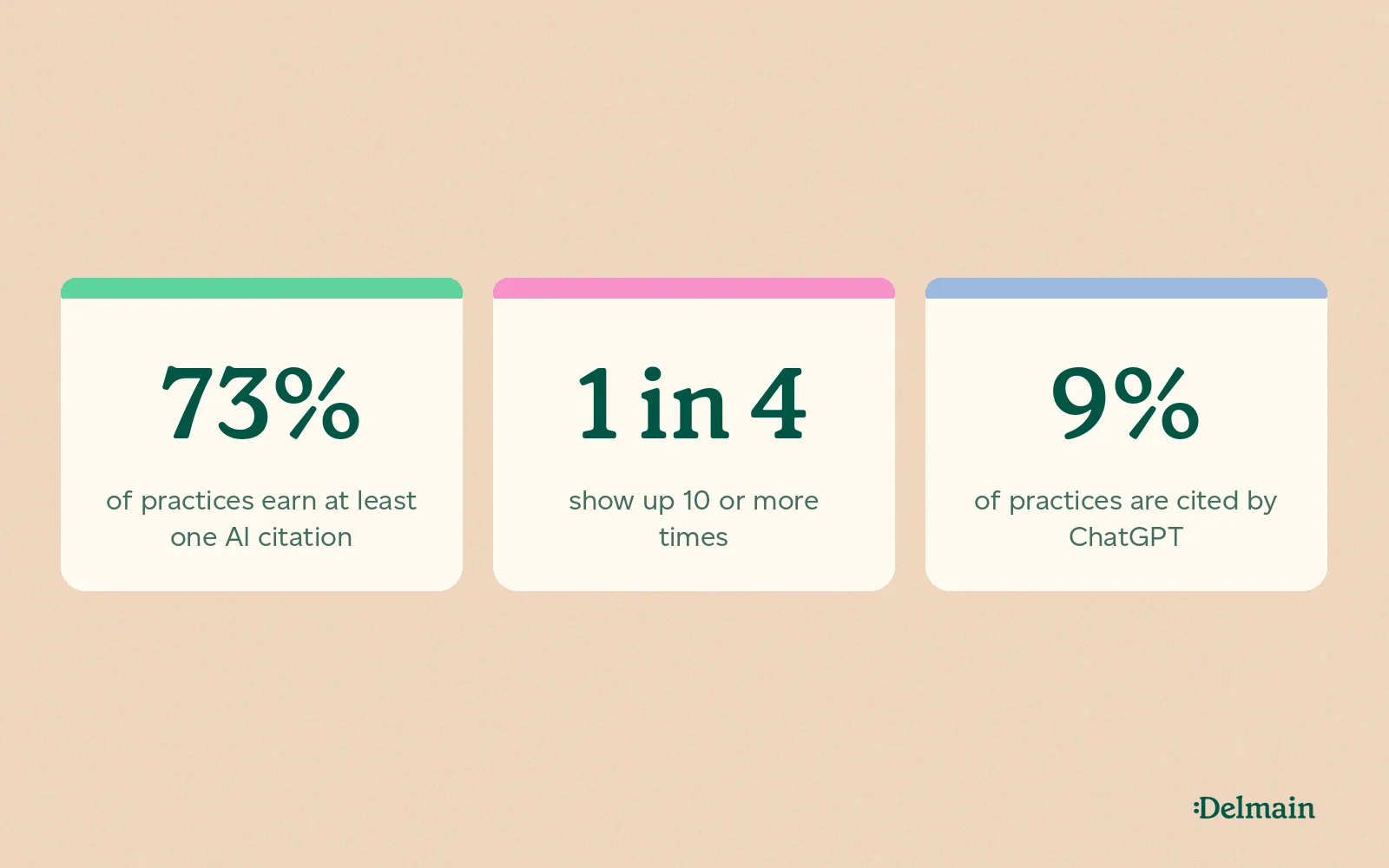
A few other especially telling insights: about 73% of dental practices show up in AI conversations while only a quarter show up 10 or more times. Also, ChatGPT (a platform with close to a billion monthly users) only cites 9% of dental practices.
Like with SEO, pack leaders are earning the lion’s share of visibility. This isn’t because they’re the best practices. It does mean, however, that quite a few good practices are digitally invisible.
AI-driven visitors are more likely to take action
Sound GEO isn’t actually the best way to get seen by the masses. It is, however, an invaluable way to find action-ready audiences.
Across industries, visitors referred by AI spend about twice as long on a page as the average visitor. We’ve seen the same hold true for dental practices. These visitors show their value by staying longer, visiting more webpages, and clicking or calling more often.
GEO for Dentists: A :Delmain Partner Success Story
Earlier this year, we helped a general practice in Florida become the most-cited practice in its region. It now earns over a thousand citations per typical month (compared with 266 for its nearest competitor), and visitors who first converse with AI are highly valuable. For this practice, 52% of website visits that start as AI conversations end with the visitor clicking online booking links.
Trust is a huge factor in AI conversations. Patients don’t necessarily trust 100% of what AI shows them by default. But when they have a conversation (asking questions and receiving personalized answers to what they really requested), they’re more likely to accept what they hear than when an ad gets pushed to them.
By giving recommendations that really match what a patient asks for, AI is able to earn more trust and better motivate follow-up action.
The more clearly dental practices can communicate with AI, the more clearly AI will be able to communicate with patients. And then trust will continue to grow, since patients will show up at your practice and get real-life validation of what AI first claimed about you.
Practices struggling with GEO struggle with SEO as well
Here’s the core principle of GEO for dentists: AI tends to cite the practices search engines already trust. Practices with no AI citations averaged 40% as many search rankings overall, while the practices earning the most citations ranked for 30 times as many search terms.
If you don’t show up in AI, you’re doubly hard to find. And as hinted above, there’s a lot of overlap in winning search results and winning AI citations.
Dental GEO isn’t permanent
Wouldn’t it be nice to earn a few citations and keep them for years to come? GEO is not a one-and-done marketing milestone, however.
We’ve seen AI citations drop by 30% or more within just 6 weeks. Like with SEO, search results have a short shelf life.
Think about it like dental hygiene. You can’t put a year’s worth of flossing into one day. Bacteria and buildup happen daily, and the totality of the internet shifts every day as well. Content ranking #1 in January might not make the map in June.
Ranking takes ongoing content creation and maintenance. Dental practices don’t need to create or update web content or Google Business Profile posts every day, but recent activity is one of many signals that helps both AI and traditional search engines offer your practice name when someone goes looking.
GEO for dentists: How to show up in AI conversations
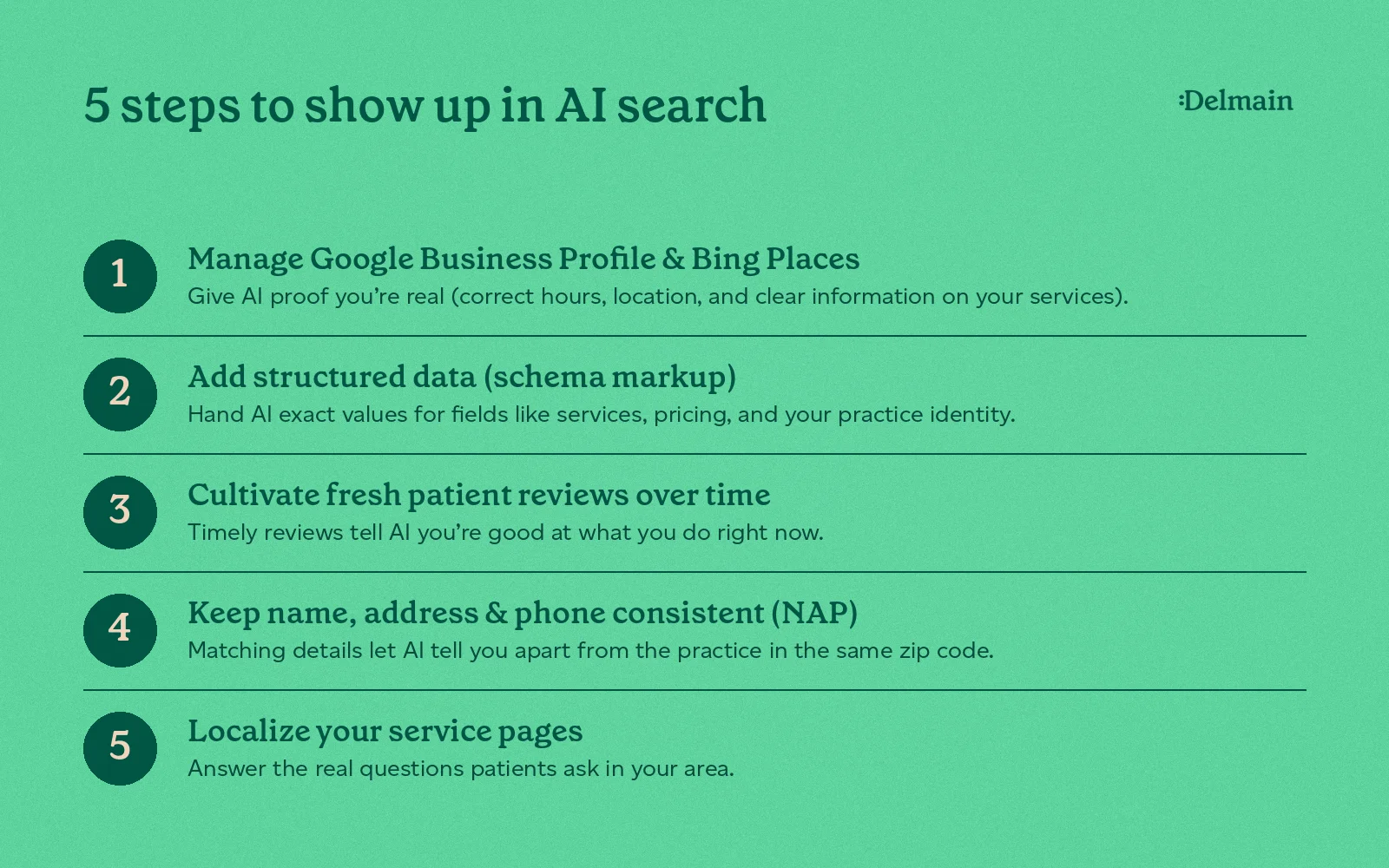
Here’s what GEO for dentists looks like day to day. A little bit of action can go a long way with AI visibility. To maximize visibility and minimize effort for dental practices we partner with, our team focuses on the following five steps. These steps will help any type of practice earn relevant AI citations and keep them over time.
Manage your Google Business Profile and Bing Places
We manage these profiles to give proof that a practice is real, along with information about when and where it operates. Before AI will cite a practice, it has to confirm details like these. It also has to make the call on whether a practice is relevant enough to matter to the user it’s conversing with.
Without the right information, AI falls back to the most likely answer. That’s where hallucinations are likely to happen, often with AI confidently providing the wrong hours, the wrong list of services for a practice, or even the wrong location.
By creating and maintaining Google Business Profiles, along with similar profiles on other search platforms, we keep trustworthy sources ready for AI to digest. This is how AI can, in turn, give accurate and reliable information to potential patients.
Adopt structured data (LocalBusiness, MedicalBusiness, Dentist)
AI platforms like Perplexity, Gemini, and ChatGPT have proven their abilities to digest prose. It’s much simpler, however, for AI to make sense of something more structured and exact.
We implement schema markup (structured data), for instance, to give AI precise values for precise fields. Schema lets AI absorb details like service pricing, hours, or the identity of your practice and read them with confidence.
Cultivate positive patient reviews over time
The practice that’s a great fit today might not be next week. When a key dentist leaves, when the office gets renovated, when new services appear, the patient experience will change. AI relies on fresh, timely reviews to understand whether that practice is good at what it does right now.
We cultivate reviews over time to create positive sentiment for a practice and to affirm that future patients are in good hands. When someone asks for the most painless place in their city to get a filling, AI leans heavily on reviews, not just what your practice claims on its own website.
Get your name, address, and phone number consistent everywhere
Your practice’s name, address, and phone number (NAP) are verifiable ways for AI to distinguish you from the practice next door. This only works if they’re consistent, though.
Our team ensures that all listings are current and correct across relevant directories. Then AI can match your reviews, your web content, and your overall reputation to your actual practice, not another one in the same zip code.
Localize web pages about your services
One of the most important questions a dental practice website can answer is what services the practice provides. Your site will ideally address this question in a localized way, mirroring how patients actually search.
We write service pages to match full-sentence questions. Instead of simply matching keywords, you can match the entire question a patient wants answered in your geographic area. Then, when patients ask these questions in AI platforms, the platform can recommend you as a clear, relevant option.
Don’t forget: GEO accuracy can’t exceed what you’ve shared about your practice
Every AI platform hallucinates on occasion. Also, an AI tool can’t tell from memory whether you’re open today or if you’re two miles away from a searcher. AI has to check live sources for details like that. If the AI can’t confirm them, it’s likely to guess.
Don’t wait for AI to guess correctly about your practice.
Frequently asked questions about GEO for dentists
What are the key benefits of using AI in dental marketing?
AI helps dental practices do more with the same marketing budget. Ad platforms like Google Ads use machine learning to adjust bids and find people most likely to book. AI tools can speed up content drafting, summarize call recordings, and flag trends in reviews. And as more patients ask ChatGPT or Google’s AI Overviews for recommendations, optimizing for AI search helps your practice show up in those answers. Human review is still essential, especially for clinical accuracy and patient privacy.
How can AI improve patient targeting strategies for dental practices?
Most AI-powered targeting happens inside ad platforms. Google and Meta use machine learning to find people whose searches, location, and behavior suggest they’re ready to book. Results depend on what you feed the system: tracking booked appointments (not just clicks or form fills) teaches the algorithm what a real new patient looks like. Separate campaigns by service, like implants versus general care, so each one learns from the right signals. And keep patient health information out of ad targeting to stay HIPAA-compliant.
How can AI-driven insights enhance patient acquisition for dental offices?
AI can surface patterns that are hard to spot. Call-tracking tools can transcribe and score calls to show which campaigns and keywords lead to booked appointments, not just phone rings. Search and review data can reveal the questions patients ask most, which can become service pages and FAQs that rank in search and get cited by AI. Then dentists can allocate more budget for the channels that bring in new patients, and less for the ones that don’t.
How is GEO different from SEO for dentists?
SEO helps your website rank in traditional search results, like Google’s list of links and the local map pack. GEO helps AI tools like ChatGPT, Gemini, and Google’s AI Overviews understand, trust, and cite your practice when they write an answer. The two overlap heavily. In our analysis of 300 dental practices, the sites AI cited most also ranked for far more Google searches. Strong SEO is the foundation, and GEO builds on it.
How can I tell if my dental practice shows up in AI search?
Start by asking AI tools the questions your patients ask, such as “Who’s a good implant dentist near me?” in ChatGPT, Gemini, and Perplexity, and note whether your practice is named or cited. Then check Google Analytics for visits referred by AI tools like chatgpt.com or perplexity.ai. For a fuller picture, SEO tools can track how often AI answers cite your website over time, which shows whether your GEO efforts are working.
It takes work to get and keep AI referring to you.
Talk with our team for a roadmap to better visibility for your practice.
About the Author
With nearly a decade of experience, Hannah is a Senior SEO Strategist who specializes in scaling organic growth through data-driven strategies and collaborative problem-solving. Her expertise lies in Local and Organic SEO, with additional experience in Google Ads, Meta Advertising, and Social Media Marketing. Passionate about aligning cross-channel strategy with long-term results, Hannah is also an active contributor in Google’s Product Expert community for Business Profile and Maps, offering insights and troubleshooting visibility challenges.

Keep Reading

20 Best Dental Websites of 2026
We’re showcasing the very best dental websites of 2026. See examples of great dental websites from around the country, learn about the best features of each, and discover opportunities to improve your dental website design.

The Essential Guide to Dental Website Hosting
Branding and Web DesignThe Essential Guide to Dental Website HostingYour website is only as strong as its host. This guide breaks down...

5 Orthodontist SEO Tips for Ranking #1 In Google
Not booking as many new patient appointments as you’d like? Feel like you just need more exposure to fully unlock the financial potential of your practice and get the patient flow your practice warrants?

Digital Marketing For Dentists: A Beginner’s Guide
Marketing your dental practice isn’t what it used to be. Even just a few years ago you could rely on word of mouth and traditional marketing to find new patients. But the world, and the way patients choose a dentist, has changed.

9 Questions To Ask Dental SEO Marketing Companies
Choosing a dental SEO marketing company isn’t a decision to be made lightly. You need to find a team who can help you achieve a positive return on your investment. It’s also important to work with a dental SEO expert whose philosophy, culture, and goals align with your own.

How to Optimize Any Web Page for SEO
So you settled on a website page idea or blog post topic and did your keyword research. Now, what do you do with those keywords? You’ll sprinkle them throughout the page, of course, but it’s not quite that simple. You need to use variations of your keywords and make sure to put them in 7 different places so search engines can find them.

Patients
Book your free intro call