Dental Patient Acquisition Costs: Real Google Ads Data By Treatment Type
Most dental patient acquisition advice quotes one vague number. Here’s what new-patient leads actually cost on Google Ads, broken out by treatment type, using real :Delmain campaign data.
- 7 min read
- Jun 2026
-
 :Delmain Team
In this article
Advice about dental patient acquisition typically quotes the same broad figures: “expect to pay $150 to $300 per new patient” or “aim for a 5-to-1 return.” This type of figure doesn’t show the one factor that most changes the math: what service you’re advertising.
The cost to bring in an implant inquiry is nothing like the cost to bring in a general patient searching for your practice by name. Lumping them into a single cost per patient number hides the whole story.
So we pulled our own numbers. This is a look at real Google Ads performance across :Delmain’s dental marketing campaigns. The data represents a rolling 120-day window, broken out by the services advertised. Instead of industry averages borrowed from 2019, we’ll show what these ads actually deliver right now.
Key Points:
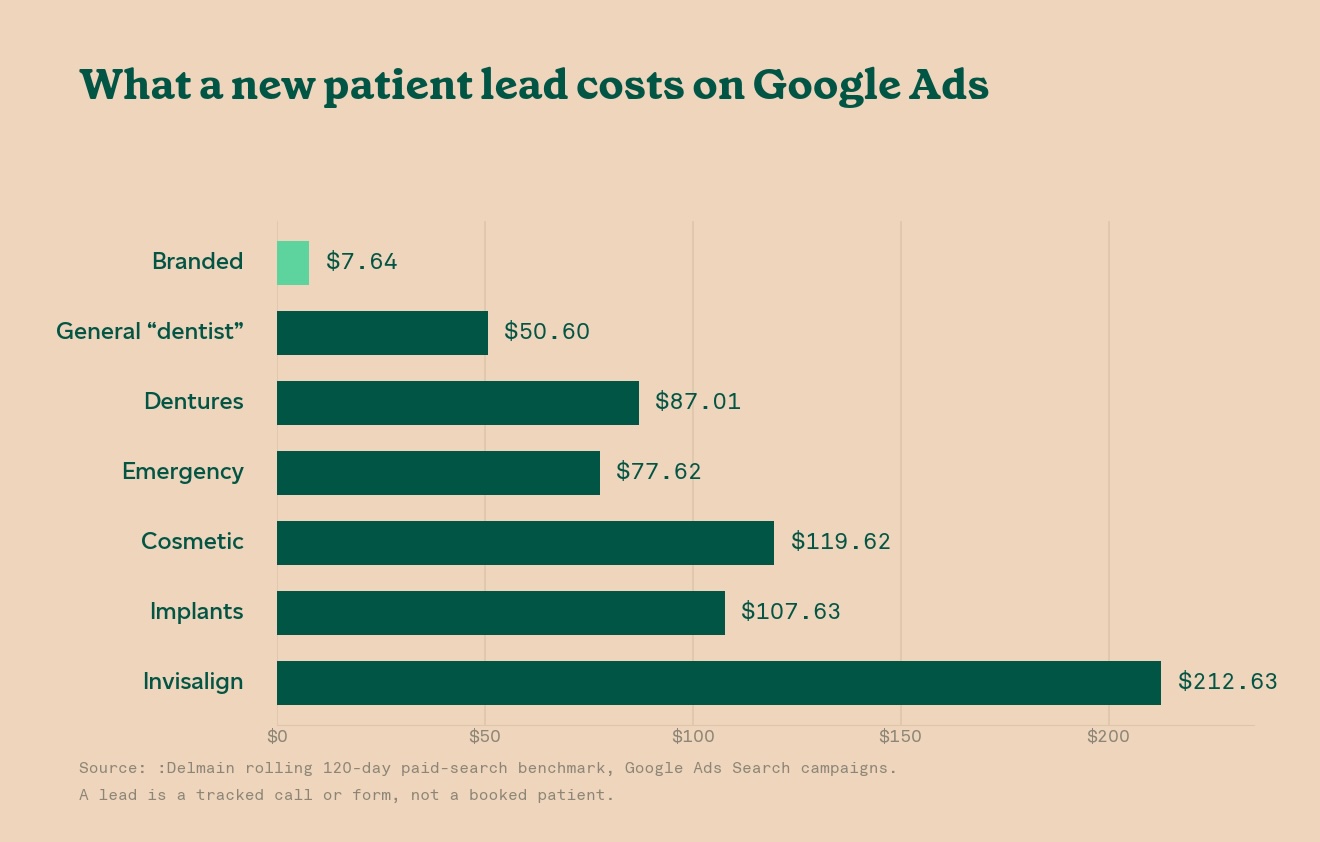
- Cost per lead swings about 28x by treatment type on Google Ads, from roughly $8 for branded searches to over $200 for Invisalign.
- Branded campaigns are the cheapest patients you’ll ever buy ($7.64 per lead at a 29.9% conversion rate), and most practices under-fund them.
- A conversion is typically a tracked lead, not a booked patient. Reading your own numbers with this caveat can highlight your true ROI.
Why a single cost per patient number falls short
What is dental patient acquisition cost?
Dental patient acquisition cost is what a practice spends on marketing to win one new patient. Calculate it by dividing total ad spend by the number of new patients that investment produced. It’s not the same as cost per lead. To convert one to the other, divide your cost per lead by the share of leads that actually book (more on that later in this article).
When someone asks about a good cost per new patient for a dentist, the answer depends on what you’re selling and where.
Search ads operate by auction. The price of a click is set by how many other practices want that same searcher and how much a resulting patient is worth to them. An implant case worth several thousand dollars gets much more aggressive bidding than a routine cleaning, so implant clicks cost more and convert less often (more people are still comparing and researching).
Geography also factors in to costs per click and ultimate ROI. The investment to win clicks in an urban area with dozens of competing dentists will be totally different than the costs for campaigns in regions with less competition.
This is why a blended average across dental offerings is misleading. If your marketing is heavy on high-value treatments in big cities, a “$150 per patient” benchmark will make you feel like you’re failing. If you’re mostly running branded and general-dentistry ads for rural areas, the same benchmark can make your marketing look incredible. Neither shows the full picture.
You need the numbers that fit your mix of dental services.
Fit your ads strategy to your offering.
Meet with our team for free insights on running Google Ads in your market, for your practice.
What dental Google Ads actually cost by treatment type
Here’s the core data. These figures show costs per conversion, averaged across the U.S. These conversions represent tracked leads, meaning calls or form submissions the ads generated, not necessarily patients who showed up and sat in the chair (more on that distinction below).
| Campaign type | Avg. cost per click | Lead conversion rate | Cost per lead |
|---|---|---|---|
| Branded (your practice name) | $2.71 | 29.9% | $7.64 |
| General “dentist” | $5.88 | 11.9% | $50.60 |
| Dentures | $11.50 | 15.5% | $87.01 |
| Emergency | $9.51 | 10.6% | $77.62 |
| Cosmetic | $6.90 | 4.5% | $119.62 |
| Implants | $8.26 | 6.3% | $107.63 |
| Invisalign | $4.57 | 3.5% | $212.63 |
Source: :Delmain rolling 120-day paid-search benchmark, Google Ads Search campaigns across our dental ad accounts (21 branded, 90 general-dentist, 29 emergency, 20 implant, 13 cosmetic, 12 Invisalign, 2 denture campaigns). Note that the data is comparatively thin for cosmetic, Invisalign, and denture campaigns, giving only directional readings.
The spread is the headline. A branded lead costs $7.64. An Invisalign or implant lead costs roughly $107 to $212. That’s close to a 14x difference for leads coming through the same platform, often for the same practice.
Implications | What this means for your budget
Don’t dismiss a category just because it’s more expensive to find the right patient. An implant patient can be worth thousands, so $100 to land an inquiry can still be an excellent trade. The point is that you can’t judge an implant campaign by what a general-dentistry campaign costs. Set the expectation per treatment, then compare each campaign against patients of that type, factoring in how many inquiries actually become cases.
Fill more chairs with Google Ads
Looking for more new patients? Let’s talk.
The cheapest patients you’ll ever buy are already searching your name
Look again at the branded row. Nothing else comes close to this cost per lead or the 29.9% conversion rate.
Branded searches are people typing your practice name into Google. They already know you, often because another channel (a referral, your SEO, a mailer, a drive-by) put you on their radar. The ad just makes sure you own the top of the page and they don’t accidentally click a competitor bidding on your name.
| Campaign | Cost per lead | vs. branded |
|---|---|---|
| Branded | $7.64 | — |
| General “dentist” | $50.60 | ~7x more |
| Implants | $107.63 | ~15x more |
Most practices either choose not to run branded campaigns or restrict them to tiny budgets. The data makes a case for another path: branded is the highest-ROI line item in most dental ad accounts, and a cheap insurance policy against competitors poaching searchers who were looking for you.
This tactic won’t grow your practice on its own. Branded demand can only grow to the number of people who already know your name. But it should rarely be the thing you cut.
Implications | Fund branded first
Fund branded ads first, since this is the cheapest conversion you can buy. Then put growth dollars into the non-branded categories that match the treatments you actually want more of.
The caveat that keeps you honest: A lead is not a patient
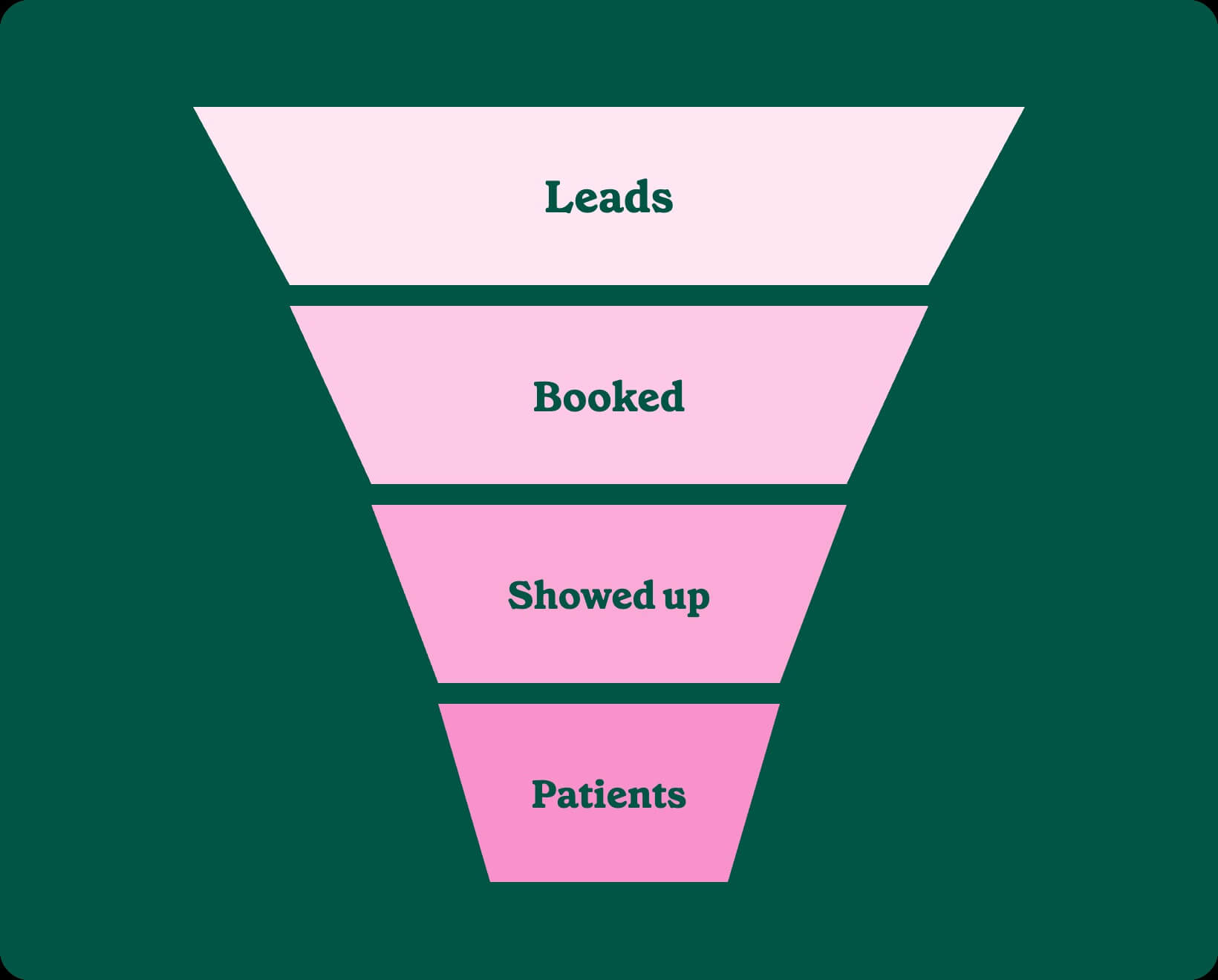
Every number above is a conversion, a tracked call or form fill. It is not a booked, showed-up, treatment-accepted patient. The gap between the two is where ROI calculations are most likely to fail.
If half your implant inquiries never book, your real cost per implant patient is closer to $200 than $100. To get an honest dental advertising ROI figure, you need three things most practices don’t track tightly: how many leads turn into booked appointments, how many of those show up, and what those patients are worth over time. The ad platform can only see the first click-to-call. The rest lives in your practice management software and your front desk’s notes.
:Delmain fills these gaps with cross-platform analytics in our proprietary PatientPulse™ dashboard. If you’re calculating the ROI on your own, you’ll need to add a few steps (shown below).
The layers involved to show ROI are not a reason to ignore costs per conversion. Getting clarity on your ROI is one of the smartest marketing decisions you can make, so we recommend a) adopting PatientPulse™ to add clarity, or b) layering your own conversion-to-patient rate on top of conversion data like we’ve shown above.
The platform cost per lead is the floor. Your operations determine the ceiling.
How to read your own dental patient acquisition data
You don’t need a data team to do this. Four steps will get you there:
1. Separate branded from everything else. If your reports blend them, your average is diluted. Branded will flatter the number, so pull it out.
2. Group the rest by treatment. Match each campaign to the treatment it promotes and compare cost per lead within the table above, not against a single benchmark.
3. Add your booking rate. Take cost per lead and divide by the share of leads that become patients. That’s your real cost per patient.
4. Compare to patient value, by treatment. A $100 implant lead and a $50 general lead can both be great or both be terrible. The value depends entirely on what each patient is worth and how many convert.
Case in point
Across the accounts in this benchmark, branded campaigns converted at 29.9%, roughly double the rate of general-dentistry search and six to seven times the rate of cosmetic or implant search. The same practices with the same advertising platforms saw wildly different results depending on intent. It’s the clearest illustration we have that who is searching matters more than how good the ad is.
In sum: Stop benchmarking against a single number
Dental advertising ROI isn’t one number. It’s a different number for every geographic market and for every treatment you advertise.
Branded leads run about $7.64, general dentistry about $50.60, and the high-value treatments like implants and Invisalign push past $100 per lead. All of those can be profitable, but none of them should be measured against the same yardstick. We go deeper on what dental advertising actually returns once booking and show rates enter the math.
Pull your branded spend out, group the rest by treatment, layer in how many leads actually become patients, and compare each line to what those patients are worth. Do that, and you’ll finally have a clear answer on advertising ROI for your practice.
Maximize your Google Ads performance
We’ve helped hundreds of other practices win new patients through Google Ads. Book an intro call today for free insights on improving yours.
Common questions about dental marketing ROI
What is a good cost per new patient for dental Google Ads?
It depends entirely on the treatment. In our 120-day benchmark, cost per tracked lead ranged from about $7.64 for branded searches to $50.60 for general dentistry and over $100 for implants and Invisalign. Compare each campaign to patients of that type in your market, not to a single blended average.
Why are implant and Invisalign ads so much more expensive?
Higher-value treatments attract more aggressive bidding. Each patient is worth more in actual collections, and searchers spend longer times researching these services, so they convert less often. Both factors push the cost per lead up, to roughly $107 for implants and $212 for Invisalign in our data.
How much does it cost to acquire a new dental patient through Google Ads?
The cost to acquire a new dental patient through Google Ads depends on the treatment. Cost per lead runs from about $7.64 for branded searches to $50.60 for general dentistry and over $200 for Invisalign. Your true cost per booked patient is higher: divide cost per lead by your booking rate.
Is cost per lead the same as cost per patient?
How do I calculate my own dental advertising ROI?
Separate branded from non-branded, group remaining campaigns by treatment, add your lead-to-patient booking rate, and compare each campaign’s cost per patient against what that type of patient is worth to your practice over time.
Do Local Service Ads or Performance Max bring in dental patients more cheaply than Search ads?
They work differently, so compare them with care. The cost per lead figures in this article are for Search ads. Local Service Ads use a pay-per-lead model, often billing $40 to $90 per lead in dentistry, while Performance Max blends Search, Display, and YouTube, so its cost per lead usually runs lower than Search alone. The right mix depends on your treatments and market, so track how many booked patients each source delivers before shifting budget.
About the Author
Stephen Taylor | Director of Marketing
Stephen has spent over a decade crafting and implementing marketing strategies across industries. His background includes agency and in-house roles across social media, email marketing, SEO, content marketing, CRM, and analytics. He was a two-time judge in the International Content Marketing Awards and frequently writes on the topics of digital marketing, books, and video game music.
Keep Reading

Best & Most Popular Dental Podcasts
Do you want to stay up-to-date on the latest dental industry trends, emerging technologies, methods for efficiently running your practice, and strategies to attract new patients? Dental podcasts offer a convenient way for dentists to stay informed and competitive.

20 Best Orthodontic Websites of 2026 & What They Got Right
Your orthodontic website can and should be your #1 source of new patients. How? By designing an orthodontic site that ranks highly in search engines, communicates what makes your practice unique, and impresses visitors. The best orthodontic websites are also designed to be mobile-first and very easy to navigate.

15 Best Pediatric Dental Websites of 2026 & What They Got Right
Parents have big expectations when entrusting their children with a pediatric dentist. The best way to make a good first impression and win them over? WOW’ing them with a well-designed pediatric website.

The Top 35 Books for Dentists of 2026
In the dynamic world of dentistry, staying informed is crucial. Wondering what books your peers are reading? We’ve got you covered with our list of the 31 best dental books for 2024, all highly recommended by dentists and dental experts.

The Truth About ADA Compliant Websites for Dental Practices in 2022
Here’s the truth — nothing you do to make your dental practice’s website ADA compliant can stop someone from suing you. If someone wants to file an opportunistic lawsuit, they can.

HIPAA Compliance For Dental Websites: Making Sense Of It All
How many emails do you get every week from an expert in HIPAA compliance wanting to sell you their services or a new piece of software? Many sales pitches focus on the fear of what might happen or what could happen if you don’t buy the latest HIPAA compliant solution.

Patients
Book your free intro call
Stop wasting marketing dollars! We’re ready to maximize success across your dental marketing efforts. Get your free consultation on targeting the right patients at the right cost. :Delmain’s plug-and-play marketing system is built for dentists, allowing you to predict, plan, and expand effortlessly.