6 Best Dental Implant Marketing Companies in 2027 (Scored)
Honest 2027 comparison of the 6 dental implant marketing companies serving full-arch practices. Scorecard methodology with named strengths and gaps for each.
- 29 min read
- Nov 2026
-
 :Delmain Team
Pick any full-arch practice in your area and pull up their Instagram profile.
If their ads look exactly like yours, you already have a problem.
That one weakness is the biggest reason full-arch practices fail to grow after the first six months with an agency.
You are charging $25,000 to $50,000 per arch, while you’re spending $30,000 to $100,000 a month on ads.
The agency running that spend has more control over your growth than any vendor in your building.
Search “best dental implant marketing company” and most of the articles you find are written by the agencies themselves. Naturally, they always come out at #1. That is not useful when you are trying to choose.
We did the opposite.
We scored six full-arch marketing agencies against the same six-point scorecard, built around the three pillars that determine whether a full-arch program scales or stalls (Marketing, Call Center, Sales). We named strengths and weaknesses for every company.
Editorial Disclosure
The Implant Engine (TIE) is a sister company of :Delmain. We have applied the same scorecard to every company on this list, including TIE. The ranking is based on the methodology below, not on our relationship. Every weakness for TIE is named in the TIE section.
Key takeaways
- Top pick: The Implant Engine (99/100) for full-arch and All-on-X practices wanting a complete system.
- Best for sales-conference culture: Progressive Dental (37/100) if you can accept templated digital ads.
- Avoid if scaling seriously: Guarantee-based agencies (Patient Excel, BiteBot).
- Methodology: Six-pillar scorecard covering custom creative, in-house dental-trained call center, sales training, track record, transparent billing, and full-arch specialization.
The full-arch scaling scorecard (methodology)
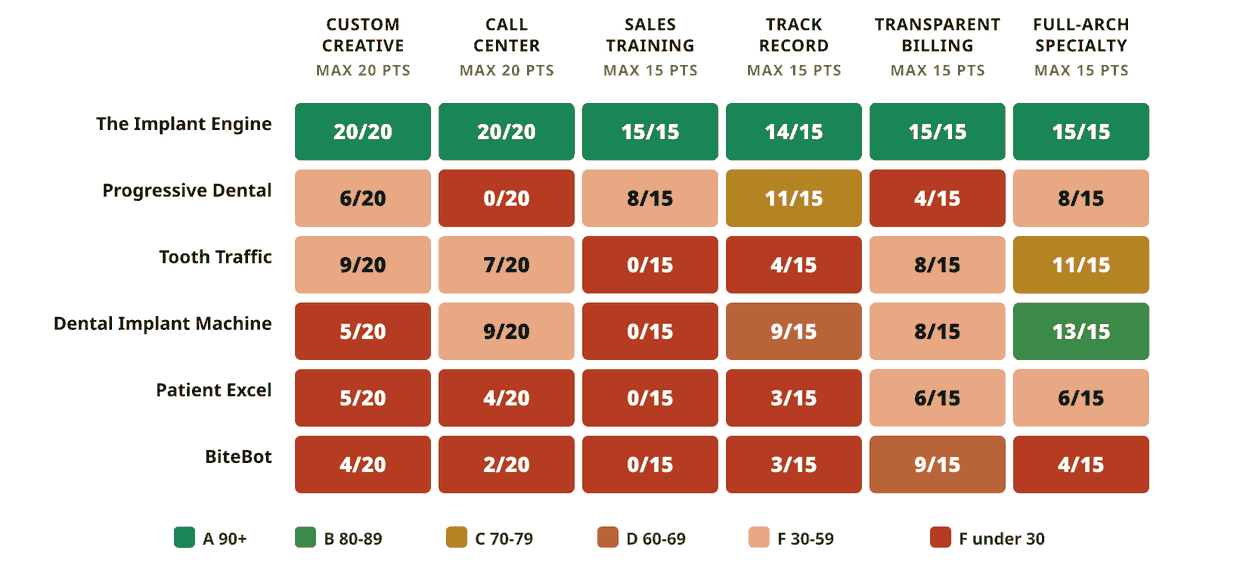
The full-arch scaling scorecard ranks dental implant marketing companies on six pillars worth 100 points total:
- Custom creative production · 20 pts
- In-house, dental-trained call center with prepaid deposits · 20 pts
- Sales training for the doctor and Treatment Coordinator · 15 pts
- Track record (named practices, published numbers, retention) · 15 pts
- Transparent billing (ad spend separated from management fee) · 15 pts
- Full-arch specialization (not general dental) · 15 pts
If you are serious about scaling full-arch or All-on-X cases at $25,000 to $50,000 per arch, your agency has to get six things right. Miss one and you will feel it within six months. Your no-show rate goes up, your close rate drops, or you burn through ad spend with nothing closed. The scorecard below is built from the three pillars that decide whether your full-arch program grows or flatlines (Marketing, Call Center, Sales).
Total possible: 100 points.
1. Custom creative production, not templated network ads (20 pts)
Custom creative means original video and ad creative shot for your specific practice, refreshed on a regular schedule.
Here is the part most practices miss. Meta punishes stale ads. Once your creative hits a 7 to 9 ad frequency score, three things happen at once. Cost per click rises. The algorithm starts feeding the ad to lower-quality leads (lower income, lower credit, less engaged). No-show rate goes up. Every week you do not refresh, you are paying more for worse leads. Templated network ads also run across multiple practices in the same agency’s portfolio, which means a competing practice across town can be running the exact same video.
Failure looks like stock footage, owner-only headshots, or creative that lives only on the website and never appears on Instagram or Facebook.
Scoring: 20 points if the agency produces custom video per practice and refreshes creative on a regular schedule. 10 if there is some customization on a templated foundation. 0 if the network runs identical creative.
The Meta frequency-score mechanic
Meta wants users to have a fresh feed experience. When the same ad runs too long, Meta pushes the ad frequency score up. At a 7 to 9 frequency, three things happen at once: cost per click rises, the algorithm routes the ad to lower-quality lead segments, and your show rate drops. Agencies running templated creative without a refresh schedule are paying more for worse leads every week the ad stays up.
2. In-house, dental-trained call center with prepaid deposits (20 pts)
An in-house, dental-trained call center is a group of dental professionals who answer leads quickly, vet on credit and income, and collect a prepaid deposit before booking the consult. Some agencies (including TIE) call this role a Treatment Setter; the function matters more than the label.
Speed to lead under one minute is the single biggest predictor of whether the patient shows up (the foundational Harvard Business Review study on lead response time found that response speed is the dominant predictor of contact rates, and the curve has only steepened with mobile). An in-house, dental-trained agent closes more full-arch leads than a generic outsourced rep, because the call involves household income, credit awareness, and financing. A prepaid deposit ($50 typical) is the only deposit type that actually moves your show rate. A phantom card hold (storing the card number for later authorization) is almost the same effect as not asking for a deposit.
Failure looks like one of these. An outsourced call center without dental training. No weekend coverage. One rep juggling multiple accounts. CRM software dressed up as a call center. A card hold that never gets charged.
Scoring: 20 points if in-house plus seven-day coverage plus prepaid deposit. 10 if outsourced or partial coverage. 0 if no call center.
3. Sales training for the doctor and Treatment Coordinator (15 pts)
Sales training is a structured program with two roles. The doctor learns to present treatment. The Treatment Coordinator learns to handle the price conversation, the objections, and the close.
Ask any owner to rate their sales process honestly. Most say a 4 or a 5. Doubling your leads into a 4-out-of-10 close process does not fix the problem. It just doubles the wasted chair time. The doctor presents the case, not the front desk. Without training, the doctor freezes the first time a patient pushes back on $50,000. That is the case lost.
Failure looks like one of three things. Leads come in with no training to back them up. Sales conferences are sold separately and never connect to the lead flow. Or the agency hands you the leads and says “your team will figure it out.”
Scoring: 15 points if there is a structured training program included. 8 if training exists as a separate paid offering. 0 if there is no training.
4. Track record (named practices, published numbers, retention) (15 pts)
Track record means published case studies with named practices, real numbers (cases closed, revenue, ROI), and a stated client retention rate.
An agency that has run the playbook 150 times has more pattern recognition than one that has run it 20 times. Retention is the strongest signal: if practices stay year over year, the system is working. Lead-quality reporting depth (credit score brackets, income, homeownership) signals the agency understands what makes a full-arch lead a real opportunity, not just a form fill.
Failure looks like anonymized case studies, screenshot-only proof, “trust us” framing, no retention number, or impressions-and-clicks reports without lead-quality data.
Scoring: 15 points if there are named case studies plus retention number plus lead-quality reporting depth. 8 if some named clients exist but reporting is shallow. 0 if no public proof.
What real lead reporting looks like
Most agencies send a report with three columns: impressions, clicks, conversions. A real full-arch reporting layer shows the percentage of leads with 650-plus credit scores, the percentage who are homeowners, average household income brackets, cost per high-quality credit-score lead, speed to lead, connection rate, and rep-level booking stats. If your agency cannot show that data, they cannot optimize for it.
5. Transparent billing (ad spend separated from management fee) (15 pts)
Transparent billing means an invoice or dashboard that shows exactly how much you paid in ad spend versus how much you paid the agency.
Bundled billing hides margin and prevents the practice from comparing platforms or shifting budget. A practice cannot evaluate ROI on each platform if the underlying spend is opaque. Private-equity-backed agencies often consolidate billing post-recapitalization, which is one of several reasons doctors evaluating long-term partnerships should know an agency’s ownership status.
Failure looks like one invoice for “marketing services,” no breakdown, ad spend taken on the agency’s credit card with no documentation passed through to the practice.
Scoring: 15 points if ad spend and management fee are separate line items. 8 if available on request. 0 if bundled into a single invoice.
6. Full-arch specialization, not general dental (15 pts)
Full-arch specialization means the agency’s full-arch program is its primary product, not a side offering tucked into a general dental package.
Full-arch patients do not book the week they start looking. They run a 2-to-3-year research cycle. They treat Instagram like a website and compare practices on case quality. If your agency runs the same approach on your hygiene patients and your $30,000 full-arch patients, you will feel it. Full-arch is its own thing. It needs fresh video on a schedule, a call center that knows how to talk about $30,000, sales training for the doctor and the TC, and an exclusive radius so you are not competing with another client across town. A general dental agency does not run any of that.
Failure looks like full-arch as one item in a service dropdown alongside ortho, hygiene, and general dental.
Scoring: 15 points if full-arch is the primary specialty. 8 if it is a stated practice area with a dedicated team. 0 if it is one offering among many.
At-a-glance comparison
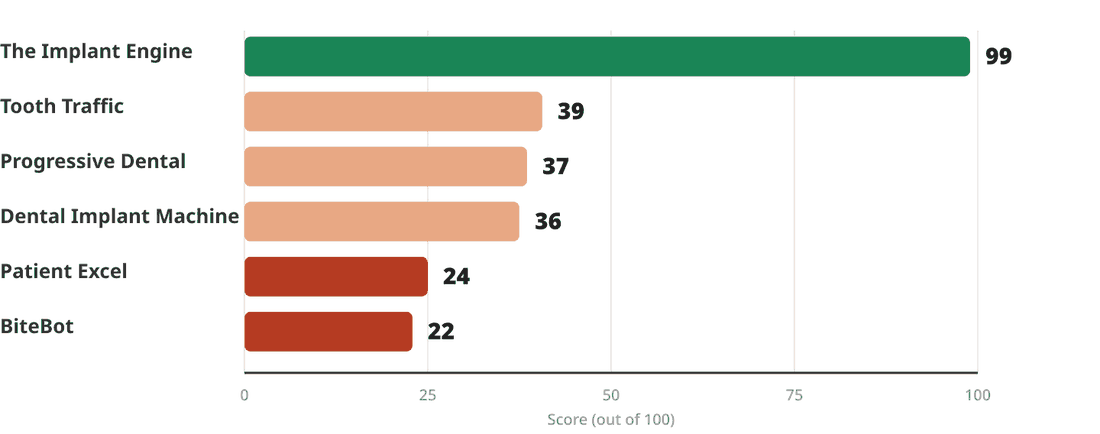
The table below summarizes how each agency scores against the six-pillar scorecard. Pricing is from publicly available sources or company-disclosed rates as of April 2026.
| Company | Specialty | Call center | Sales training | Score | Best for |
|---|---|---|---|---|---|
| The Implant Engine | Full-arch only | In-house, 7 days, $50 prepaid | Full Arch Academy (incl.) | 99 | Complete-system practices |
| Progressive Dental | General + implants | None | The Closing Institute (separate) | 37 | Sales-conference culture |
| ToothTraffic | Full-arch | Card-on-file at consult | None | 39 | First-time testers |
| Dental Implant Machine | Full-arch | Weekday, card hold | None | 36 | Google-Ads-led |
| Patient Excel | Full-arch | Outsourced | None | 24 | Risk-tolerant testers |
| BiteBot | AI software | AI bot only | None | 22 | Self-managed AI |
1. The Implant Engine (TIE)
Score: 99/100
The Implant Engine is a full-arch-only marketing agency. It has scaled 300-plus practices. The system has five parts: custom creative, in-house Treatment Setters, prepaid deposits, doctor and TC training, and transparent billing.
- Founded: 2020
- Specialty: Full-arch / All-on-X only
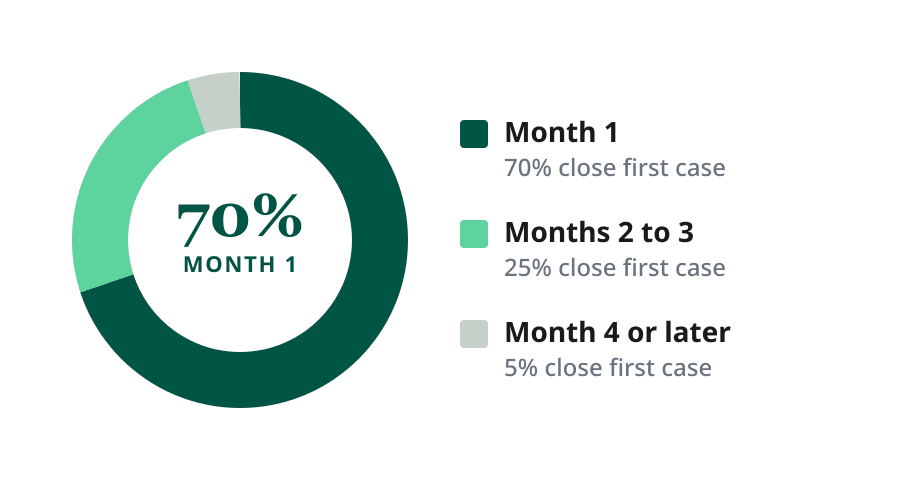
- Headline stats: 300-plus practices, ~$250M closed since 2023, 95% retention, 70% of practices close their first case in month one
✓ Strengths
- Custom video shoots for every practice; no shared network creative
- In-house Treatment Setter call center, 8am-8pm seven days a week, with AI overnight callbacks
- 20-second average speed to lead
- $50 prepaid deposit (works for ~70% of clients)
- AI overnight callback so leads do not sit between 8 p.m. and 8 a.m.
- Lead-quality reporting at credit-score and income level
- Full Arch Academy training included for doctor and TC
- Transparent billing: ad spend on practice’s card, fee separate
- 300+ practices, ~$70M closed in 2025, 95% retention
- 70% of practices close their first case in month one
✕ Gaps
- Full-arch only; not for general dental marketing
- Built for practices ready to commit to scaling full-arch, not for owners running a low-budget exploratory test
- One practice per zipcode (or similar radius) under the exclusivity policy; if a competitor in your market signed first, you’ll be put on a waitlist
Public case studies: Winterholler ($615,000 in three months), Burns, Glen Dental, Thomaston, Care Dental, Advanced Dental.
Pillar-by-pillar breakdown (Total 99 / 100)
| Pillar | Score | Notes |
|---|---|---|
| Custom creative | 20/20 | Custom video shoots per practice, refreshed on a defined schedule. No shared creative. |
| Call center | 20/20 | In-house Treatment Setters, dental-trained, 8am-8pm seven days, plus AI overnight callbacks 8pm-8am, $50 prepaid deposit. AI overnight callback. 20-second speed to lead. |
| Sales training | 15/15 | Full Arch Academy included. Doctor case-presentation track plus separate Treatment Coordinator track. |
| Track record | 14/15 | 300+ practices, ~$70M closed in 2025, 95% retention, 70% close first case in month 1. Lead-quality reporting at credit and income level. |
| Transparent billing | 15/15 | Ad spend on practice’s card, management fee billed separately. Pricing is custom-quoted per practice. |
| Full-arch specialization | 15/15 | Full-arch and All-on-X is the entire product, not a sub-service. Maximum specialization on the dimension this scorecard rewards. |
Pricing: Custom, quoted per practice. Practices control ad spend directly (typically $30,000 to $100,000 a month for full-arch). Optional video production package quoted separately.
Best for: Full-arch practices charging $25,000 to $50,000 per arch that want a complete system, not just leads.
Skip if: You are not doing full-arch or All-on-X.
How does your full-arch program compare to 300 other practices?
We have run this scorecard on 300+ practices closing $25K to $50K cases. Book a 30-minute review and we will show you where your numbers sit against the benchmark, and exactly which pillar is holding you back.
2. Progressive Dental
Score: 37/100
Progressive Dental is the largest and oldest agency in the dental implant marketing category, founded in 2009 by Bart Knellinger. It is best known for The Closing Institute (TCI) sales conference and its high-volume website production.
- Founded: 2009 by Bart Knellinger
- Headquartered: Clearwater, Florida
- Specialty: General dental marketing plus implants
- Headline stats: 1,000-plus active dental practice clients, $60M revenue in 2023
✓ Strengths
- The Closing Institute (TCI): largest dental sales event by attendance
- Polished, professional sales process
- First to market; high brand recognition with 1,000+ active clients
- High-volume website production capacity (templated – not ideal)
✕ Gaps
- No in-house call center; leads dumped on the practice front desk
- Templated creative across the website portfolio and ad accounts
- Long-form video lives only on the website, not Instagram or Facebook
- Bundled billing; ad spend hidden inside management fee
- 12-month contracts with limited early-termination flexibility
- Heavy Google Search reliance in markets where chains outbid private practices
- The Closing Institute is a sales conference, not a structured training curriculum, and is sold as a separate paid offering on top of marketing services (pricing not publicly disclosed)
Context: $100M private equity recapitalization in 2024 (McCarthy Capital). Expect pricing and service decisions tied to investor returns going forward.
2024 ownership change
In May 2024, Progressive Dental took on a $100 million recapitalization from McCarthy Capital, a Nebraska-based private equity firm. Bart Knellinger remains CEO. The stated purpose is international expansion and accretive acquisitions. (Sources: BusinessWire, Dentistry Today, Business Observer.)
For doctors evaluating a long-term agency partnership, PE-backed growth typically accelerates changes to pricing, product mix, and account-management staffing. Whether that is positive or negative depends on what the practice values in an agency relationship.
Pillar-by-pillar breakdown (Total 37 / 100)
| Pillar | Score | Notes |
|---|---|---|
| Custom creative | 6/20 | Templated copy and ad creative across the network. Multiple practices in the same metro area can run identical landing pages. |
| Call center | 0/20 | No in-house call center. Leads sent directly to the practice front desk. No vetting, no deposit collection, no Treatment Coordinator handoff training. |
| Sales training | 8/15 | The Closing Institute is a sales conference, not a structured training curriculum embedded in the agency engagement. It exists as a separate paid offering, not included with marketing services. |
| Track record | 11/15 | 1,000+ active clients, $60M revenue in 2023. No published retention number, shallow lead-quality reporting. |
| Transparent billing | 4/15 | Bundled billing is the standard. Practices report difficulty getting ad spend separated from management fee. |
| Full-arch specialization | 8/15 | General dental marketing plus implants. Full-arch is one offering among many, not the primary product. |
Pricing: Not publicly disclosed. The Closing Institute is sold as a separate paid offering on top of marketing services; pricing is provided on a sales call.
Best for: Practices that value sales-conference culture and accept templated digital ads.
Skip if: You need an in-house call center, transparent ad-spend billing, or month-to-month flexibility.
3. Dental Implant Machine (DIM)
Score: 36/100
Dental Implant Machine was second to market in the full-arch agency category, founded in 2017 and headquartered in St. George, Utah. It built its reputation on Google Ads volume and an in-house call center.
- Founded: 2017
- Headquartered: St. George, Utah
- Specialty: Full-arch implant marketing
- Headline stats: $150M+ in client cases booked (per company website), $375M+ in total system-attributed cases booked
✓ Strengths
- Established 2017, second to market in the full-arch agency category
- In-house call center (weekday coverage, one rep across multiple accounts)
- $150M+ in client cases booked, per company website
- Full-arch specialization is the primary product
✕ Gaps
- Templated Meta ads run across multiple practices
- One rep typically manages multiple accounts; no weekend coverage
- Card-on-file hold only, not a prepaid deposit charge
- No sales training program for doctor or TC
- Exclusivity radius removed; clients can run in the same metro area
- Heavy Google Search reliance in markets where chains outbid private practices
- Co-owner Dewey Denning has equity in both DIM and Nuvia (a national full-arch chain). Was publicly documented and has since been scrubbed from agency materials, but the shared ownership is a real conflict-of-interest signal for independent practices in or near Nuvia markets
Conflict-of-interest note
As of 2024, DIM’s About page publicly listed Nuvia (a national full-arch implant chain) as a flagship consulting client, alongside Heartland Dental and North American Dental Group. Both DIM and Nuvia are headquartered in St. George, Utah. The current page no longer surfaces these names, but the prior client relationships are documented.
The relationship is more than client-and-agency. Does Dewey Denning own Nuvia? Yes. Denning is publicly listed as the owner of Nuvia Dental Implant Center across multiple independent business directories. Denning also co-owns DIM. The shared ownership was previously visible across DIM’s public materials and has since been scrubbed, but the equity relationship is a matter of public record.
For independent practices, this is worth surfacing on the discovery call. If your agency has equity in a national chain that operates in (or is expanding into) your market, ask directly how that conflict is managed before signing.
Pillar-by-pillar breakdown (Total 36 / 100)
| Pillar | Score | Notes |
|---|---|---|
| Custom creative | 5/20 | Templated Meta ads run across all client practices. Doctor in one market may compete with another DIM client running identical video. |
| Call center | 9/20 | In-house call center available. No weekend coverage. Card-on-file hold, not prepaid deposit. |
| Sales training | 0/15 | No included sales training program for the doctor or Treatment Coordinator. |
| Track record | 9/15 | $150M+ in client cases booked. Co-owner Dewey Denning also has equity in Nuvia; relationships with Heartland and NADG were publicly listed as of 2024. No published retention number; shallow lead-quality reporting. |
| Transparent billing | 8/15 | Pricing not publicly disclosed. Standard line-item billing reported by clients but not formally documented. |
| Full-arch specialization | 13/15 | Full-arch is the primary product. Strongest pillar for DIM. |
Pricing: Not publicly disclosed. Practices report management fees in the $2,000 to $4,000 a month range based on services bundled.
Best for: Established practices wanting a Google-Ads-led program that are comfortable with DIM’s co-owner holding equity in Nuvia.
Skip if: You need weekend call-center coverage, prepaid deposits, or a real sales-training program.
4. ToothTraffic
Score: 39/100
ToothTraffic is a full-arch lead generation agency that pre-screens patients for financial readiness and books consults with a card-on-file reservation. It markets a refund guarantee for practices that do not close cases.
- Origin: Founded and grown within a partner implant practice in Arizona
- Specialty: Full-arch lead generation, US-based
- Headline stats: Claims an 80%+ card-on-file rate at consult booking. Reports producing 30 video ads per practice per month from an in-house team in the partner practice.
✓ Strengths
- Better creative than templated peers (uses video, not stock imagery)
- Faster onboarding than legacy agencies
- Refund-guarantee marketing reduces buying friction at the entry point
✕ Gaps
- No custom video production per practice
- No sales training for doctor or TC
- No website builds, no SEO, narrower scope
- No published case studies with named practices
- No published online reviews from operating practices
- Card-on-file at consult booking only; almost the same effect as not asking for a deposit
- Refund covers agency fee only; ad spend stays on the practice
Pillar-by-pillar breakdown (Total 39 / 100)
| Pillar | Score | Notes |
|---|---|---|
| Custom creative | 9/20 | Uses video instead of stock imagery. Still templated across the client base; no per-practice production. |
| Call center | 7/20 | Card-on-file reservation at consult booking. Not a true prepaid deposit charge. No weekend / 7-day coverage detail published. |
| Sales training | 0/15 | No sales training program for doctor or Treatment Coordinator. |
| Track record | 4/15 | No published case studies with named practices, no revenue numbers, no online reviews. |
| Transparent billing | 8/15 | Pricing not publicly disclosed. Refund guarantee covers agency fee, not ad spend. |
| Full-arch specialization | 11/15 | Full-arch focused. Lead generation only. They do not run the call center or training. |
Pricing: Not publicly disclosed.
Best for: Budget-constrained practices testing full-arch lead generation for the first time who want a refund-backed entry point.
Skip if: You need custom creative, sales training, or named case-study proof.
5. Patient Excel
Score: 24/100
Patient Excel is a newer full-arch lead generation entrant that markets a “we work for free until you succeed” guarantee model and pre-qualification claims. Public information on the company is limited.
- Specialty: Full-arch lead generation, rev-share model
- Headline stats: Not publicly disclosed
✓ Strengths
- No upfront agency-fee commitment; rev-share lets a practice test the model without writing the agency a check on day one
- Sales pitch (pre-qualification, refund guarantee) is polished enough to land on discovery calls
✕ Gaps
- Outsourced and not dental-trained call center with accent and trust issues
- No prepaid deposit collection workflow
- Pre-qualification on cold leads does not work in practice
- No real published case studies, no in-house content production
- No sales training program
- Rev-share covers agency fee only; ad spend (the bigger number) stays on the practice
- A failed 3-month engagement still costs $90K to $300K in wasted ad spend, regardless of guarantee
The pre-qualification myth
Several newer agencies pitch pre-qualification as a feature: they collect credit score and card information from a cold ad before the appointment. In practice, this rarely works. The patient has not been sold yet, no value has been built, and lead volume drops off a cliff because most patients will not share that information with a cold caller.
The reframe most successful full-arch agencies use: vet through conversation about income, homeownership, and readiness, then collect a $50 prepaid deposit. The deposit is the real behavioral filter.
The real cost of “we work for free”
The “work for free” guarantee never covers ad spend, which is roughly 80% of the total full-arch marketing cost. A practice running this model still pays $30,000 to $100,000 a month in ad spend during the trial period.
If the agency fails, the practice has lost three to four months of growth time, $90,000 to $300,000 in wasted ad spend, plus team burnout from chasing unqualified leads. Guarantees do not create success. Infrastructure does.
Pillar-by-pillar breakdown (Total 24 / 100)
| Pillar | Score | Notes |
|---|---|---|
| Custom creative | 5/20 | Templated creative. No in-house content production team. |
| Call center | 4/20 | Outsourced call center without dental training. No prepaid deposits. Accent and trust issues for $30K case conversations. |
| Sales training | 0/15 | No sales training program. |
| Track record | 3/15 | No real published case studies. Public information is limited. |
| Transparent billing | 6/15 | Rev-share on the agency fee. Ad spend (80% of total cost) still on the practice. |
| Full-arch specialization | 6/15 | Full-arch lead generation. No supporting system (call center, training, content) to scale the back end. |
Pricing: Rev-share on agency fee. Ad spend on the practice’s card.
Best for: Practices that want a low-fee guarantee model and accept higher operational risk.
Skip if: You want a real call center, sales training, named case studies, or transparency on results.
6. BiteBot
Score: 22/100
BiteBot is an AI dental marketing software product, not a full-service agency. It is positioned as an “in-house growth engine you control for 10% of the price of traditional marketing agencies.” The closer comparison is to a SaaS tool, not to TIE or Progressive Dental.
- Founder: Shanta, working with dental practices since 2018
- Specialty: AI software for dental marketing automation
- Headline stats: Per the BiteBot website, 100+ proven ad templates that have generated $30M+ in treatment. The homepage walkthrough video literally shows you picking from a template library.
- Pricing (per bitebot.io/plans): Starter $297/mo (3 users), Pro $697/mo (10 users, adds AI calling receptionist, AI text setter, and landing pages), Max $1,297/mo (unlimited users, adds SEO and a dedicated success manager), all billed annually. SmileGen $97/mo standalone, $297/mo Pro. Ad spend, calls, and SMS billed separately.
✓ Strengths
- $297/mo Starter pricing, well below typical agency fees
- No contracts, cancel anytime, and a 30-day guarantee (per BiteBot)
- AI bot replies to leads within 30 seconds with basic info
- SmileGen tool has clinical merit as a consult-room visualization aid
- Self-serve, practice-controlled
✕ Gaps
- No live call center; lead follow-up is AI-only
- The model is self-pick from a shared template library (ads, funnels, landing pages). Every practice on BiteBot is choosing from the same set, so you end up running the same creative as other practices in your market and look like one of many
- BiteBot’s pricing page lists no done-for-you custom creative tier; ads come from the Ad Studio generator included in every plan
- No agency accountable for results. If the templates do not convert, that is on the practice to figure out
- No sales training for doctor or TC
- Built for software efficiency, not full-arch operational depth
Category note: BiteBot is a software product you run yourself, not a full-service marketing agency that runs the work for you. We score it against the same six pillars for consistency, but a fairer comparison would be to other software tools, not to agencies like TIE or Progressive. Important caveat: because the model is self-pick from a shared template library, the practice is on the hook for results. There is no agency accountable when the templates do not convert.
Pillar-by-pillar breakdown (Total 22 / 100)
| Pillar | Score | Notes |
|---|---|---|
| Custom creative | 4/20 | Self-pick from a shared template library. Every BiteBot practice runs creative from the same pool, so you blend in instead of standing out. No custom production tier is listed on BiteBot’s pricing page. No per-practice custom video on any listed plan. |
| Call center | 2/20 | AI bot only. Not equivalent to a dental-trained human agent on a $30K case conversation. |
| Sales training | 0/15 | No sales training program. |
| Track record | 3/15 | Founded 2023. Limited published full-arch case data at the volume of established players. |
| Transparent billing | 9/15 | Public flat-rate pricing on the website. Ad spend handled directly by the practice. |
| Full-arch specialization | 4/15 | Multi-procedure (general dental, ortho, full-arch). Not a full-arch specialist. |
Pricing: Starter $297/mo, Pro $697/mo, Max $1,297/mo (all billed annually) per the plans page. No contracts, and BiteBot advertises a 30-day guarantee. Ad spend, calls, and SMS billed separately.
Best for: Solo and small practices wanting an inexpensive AI software experiment, not a full-service marketing partner.
Skip if: You are scaling full-arch and need a real call center, custom creative that is not from a shared template pool, sales training, or an agency accountable for results.
General dental marketing agencies that also do full-arch (Microsite, Gilleard)
A handful of general dental marketing agencies occasionally take on full-arch work. They are best treated as complementary partners alongside a full-arch specialist, not replacements.
Microsite Health has an in-house call center, which was a real differentiator when the agency entered the implant space. Ad creative across the client base is generic, but the agency does not specialize in full-arch case dynamics. Best as a general dental marketing partner alongside a full-arch specialist.
Gilleard produces a strong All-on-X magazine mailer that several full-arch practices report drives consults reliably. There is no digital ad team and no call center. Best as a direct-mail partner running alongside a digital-first agency.
Companies excluded from this comparison: HIP Creative (orthodontics-focused, not full-arch), Maxilla (general dental SEO), and other generalist agencies that occasionally run implant campaigns but do not have the full-arch system to scale them.
Red flags when choosing a dental implant marketing company
The list below is the short version of what causes full-arch agency relationships to fail. Walk away if you see any of these on the discovery call.
- Big guarantees with no published case studies. New agencies use guarantees because they do not have a track record. Established agencies with real results do not need them.
- Pre-qualification claims on cold leads. It does not work in practice. The patient has not been sold yet, and lead volume drops sharply when the agency tries.
- Outsourced and not dental-trained call center with no deposit collection. Bad show rates, accent and trust issues, no representation of the practice brand.
- Phantom card holds presented as deposits. Statistically equivalent to no deposit. Only a prepaid charge moves the show rate.
- Bundled billing with no separation of ad spend and management fee. You cannot evaluate ROI on individual platforms or shift budget intelligently.
- Same ad creative running across every practice in the agency’s portfolio. Your competitor across town is running the same ads.
- 12-month lock-in with no flexibility and no published retention number. Established agencies with strong retention offer shorter tiers because they do not need to lock practices in.
How full-arch patients actually find a practice (the 2-to-3-year research cycle)
Full-arch patients do not book the week they start looking. They research for two to three years. They watch testimonials over and over. They save them to favorites. By the time they call you, they already feel like they know you, or they don’t. If your agency is only producing video for your website, you are missing the whole middle of that journey.
The research cycle runs through three stages.
STAGE 1
Awareness
- Patients first encounter the procedure through a friend, a family member, or social content.
- They start researching All-on-4, All-on-X, and full-arch implants in general.
- They are not yet attached to a specific practice.
STAGE 2
Consideration
- Patients shortlist three to five local practices and start comparing.
- They check the website, then the Instagram profile, then watch testimonial videos repeatedly.
- Many patients save testimonial videos to favorites and rewatch them over weeks.
- Instagram functions as the second website. Patients return to it more often than the website during this stage.
STAGE 3
Decision
- Patients book a consult after months of accumulated comfort with the practice brand.
- The booking call is the end of the journey, not the start.
Agencies that produce video for the website only (Progressive is one such example) miss stages two and three of this cycle.
Patients who would have shortlisted the practice never see the testimonial content because it never appears in their Instagram feed.
The case acceptance rate at the consult drops because the patient has not built up the same level of trust they would have with practices running social content.
Five questions to ask before you sign with any dental implant marketing company
Run these five on any discovery call. The answers tell you whether the agency owns the full system or only one piece of it. Listen for specifics. Hesitation, hedging, or “we can do that” without process detail is the tell.
1. Do you shoot custom video for my practice, or run the same ads across your client list?
Creative is where most agencies cut corners. Stock testimonials and brand-only ads are cheap to produce and easy to recycle. The problem is that full-arch patients spend two to three years researching before they pick a practice, and they remember faces. If they have already seen the same testimonial running for another implant practice in the next metro, the trust is gone before the consult.
A good answer: “Two production days at your practice, around 40 finished videos cut for Reels, Stories, paid social, and your website, enough content to run for 12 months. Patient transformation stories, doctor spotlights, social clips, and practice videos. You will not see another practice in our portfolio running your creative.”
If the answer is “we have a library you can pick from” or “we use proven creative across the network,” you are paying agency rates for templates.
2. Is your call center in-house, and what hours does it cover?
A full-arch lead is worth $20,000 to $50,000 in revenue. The first 20 seconds after the form fill decide whether that lead converts or vanishes. An outsourced rep without dental training, no dental context, no script for the price objection, and no access to your calendar will lose more leads than the ads ever generate. Hours matter as much as staffing. Most full-arch inquiries arrive after 5pm and on weekends, when patients have time to think. If the call center is closed, the leads are cold by Monday.
A good answer: “In-house, dental-trained reps, 8am-8pm seven days a week, with AI overnight callbacks 8pm-8am. You can see how each rep is performing, how fast they reach leads, and how many patients actually show up, broken down by ad source.”
If the answer is “we have a partner overseas” or “the front desk picks up during business hours,” that is not a real call center.
3. Do you collect a prepaid deposit before booking? How much, and is it actually charged?
This is the cleanest single test of whether an agency understands full-arch economics. A no-deposit booking has a show rate of 30% or lower. A $50 prepaid charge moves that to 78%. Practices waste $200 to $400 per no-show in chair time and Treatment Coordinator time. On 40 consults a month, the math is enormous.
Watch for sleight of hand here: some agencies say “yes, we collect a deposit” but use a card hold instead of a real charge. Holds release within days and do not change patient behavior.
A good answer: “$50 prepaid, charged on the booking call, refundable if the patient shows up.”
If the answer is “we collect a hold” or “we ask for a card on file,” that is almost the same effect as not asking.
4. Do you train my doctor and Treatment Coordinator on full-arch sales presentations?
The agency can run flawless ads and hand you 40 vetted, deposit-paid consults a month. If your doctor is not trained to handle the price objection and your Treatment Coordinator is not trained on the financial conversation, your close rate will sit around 15%. Trained practices close at 35% to 40%. That is the difference between a 10x ROI and a program that does not pay back. Sales training is not a bolt-on. It is half the system.
A good answer: “Included. We have a structured program for the doctor presentation, a separate track for the Treatment Coordinator on financial conversations and case acceptance, and we coach against recorded consults on a monthly cadence.”
If sales training is “available separately” or “we can recommend a program,” the agency does not own the close.
5. Can I see ad spend and management fee as separate line items on my invoice?
Bundled billing is the most common way agencies hide poor performance. If you cannot see what was spent on Meta versus Google versus YouTube, you cannot reallocate budget when one channel underperforms, and you cannot tell whether the agency is keeping margin on ad spend. Ad spend should run on your card, on your accounts, with platform billing visible to you in real time. The agency fee should be a separate, fixed line item.
A good answer: “Ad spend runs on your card directly. You see Meta and Google billing in your accounts. Our management fee is billed separately.”
If the answer is “we send you one invoice that covers everything,” you are paying to be kept in the dark on what your money is actually doing.
If the agency answers “no” or “kind of” to two or more of these, the system has gaps that will surface inside six months.
Run the five questions on a TIE intro call
Hear the full version of these answers applied to your specific market.
Frequently asked questions
How much does dental implant marketing cost in 2027?
Typical full-arch agency engagements run $2,500 to $5,000 a month in management fee, plus $30,000 to $100,000 a month in ad spend. Practices in saturated metros (LA, Houston, Chicago, NYC) sit at the top of that range. Lower-cost markets sit at the bottom. Beware bundled billing that hides the breakdown.
What is the average cost per full-arch case acquired?
A well-structured full-arch or All-on-X marketing campaign runs at a 10x return on ad spend (10% ad spend to revenue) by 90 days. Top performers hit 12x or higher; The Implant Engine reports 20% of its partner practices exceed 15x. Anything below a 7x ROI signals a breakdown in lead quality, show rates, or case acceptance, not the ads themselves. On TIE-managed campaigns, the average marketing cost per arch sold is around $2,000, or 10% of production value.
What is the difference between a general dental marketing agency and a full-arch specialist?
A complete full-arch system has five parts working together:
- Professional video ads featuring the doctor.
- An in-house call center contacting every lead within 20 seconds and collecting a deposit.
- Treatment Coordinator training. Full-arch programs target a 35% to 40% close rate against an industry baseline of 15% or less, per the Full Arch Academy training benchmarks.
- A high-conversion website built for implant patients.
- Real-time dashboards showing ad spend through closed arches.
Most general agencies handle only the first part and leave the rest to the practice.
What is a fair monthly ad spend for a full-arch practice?
In a competitive metro, expect $50,000 to $100,000 a month to compete. In a smaller market, $20,000 to $40,000 can work. Below $20,000 a month, full-arch volume becomes inconsistent because the agency cannot generate enough Meta or Google data to optimize.
What is a Treatment Setter, and why does it matter for full-arch?
A Treatment Setter is a former dental-industry professional who handles the full-arch lead pipeline separately from your front desk. They understand the clinical process, the financial conversation, and the patient psychology around full-arch. They screen each lead for income, credit, and ability to handle monthly payments, then book vetted patients on your calendar with a $50 deposit. The result on a TIE-managed call center is a 78% show-up rate against an industry average below 50%. Front-desk staff are not trained for that vetting, and outsourced reps without a dental background cannot represent the practice brand in a $30,000 conversation.
Why does a $50 prepaid deposit matter? Is a card hold the same thing?
A prepaid deposit is charged on the booking call and is refundable if the patient shows up. That framing matters. You are asking for a small commitment that proves they are serious. Most vetted leads have no issue with it; the ones who refuse were unlikely to show up anyway. That is the filter working. A card hold, by contrast, only stores the card number for a future authorization that often never happens. Card holds are almost the same effect as not asking for a deposit at all. Only prepaid deposits move the show rate.
Should I take a guaranteed-results offer?
Guarantees do not cover ad spend, which is roughly 80% of the total full-arch marketing cost. A 3-month guarantee that fails costs the practice $90,000 to $300,000 in wasted ad spend plus three months of lost growth time. Established agencies with real case studies do not need guarantees.
Should I run Google Ads or Meta Ads for full-arch?
Both platforms reach patients who are actively shopping and patients who are earlier in their research. Meta uses video to build trust and familiarity with the doctor before the patient ever calls. Google captures patients at the moment they are searching for a specific procedure or provider. Most successful full-arch practices run both. The Implant Engine reports that Meta typically drives 60% to 70% of consult volume and Google drives 20% to 30%. Watch ad frequency score on Meta. If your agency is not refreshing creative on a regular schedule, you are paying more for worse leads every week.
What does real lead-quality reporting look like?
Real reporting shows the percentage of leads with 650-plus credit scores, the percentage who are homeowners, average household income brackets, cost per high-quality lead, speed to lead, connection rate, and rep-level booking stats. If your agency cannot show that data, they cannot optimize for it.
Do these companies serve practices outside the United States?
Most are US-focused. The Implant Engine is the broadest of the group and works with practices in the US, Canada, the UK, and Australia. Implant Elevate (TIE’s video-production arm) can work with practices anywhere. Most other agencies on this list focus on the US and Canada only.
The honest take
Every agency on this list does at least one thing well. That is why a practice signed with them in the first place.
Progressive’s TCI conference gives doctors useful exposure to sales concepts, even if it is a conference rather than an ongoing training program.
DIM has been running full-arch campaigns longer than most newer entrants.
BiteBot’s SmileGen tool has clinical merit on its own as a consult-room visualization aid, separate from the marketing software.
If you are doing full-arch cases at $25,000 to $50,000 each, the difference between a complete system and a half-built one shows up in the first six months. That holds at $5,000 a month in ad spend and at $100,000 a month. You do not grow into needing the full system. You need it from day one.
That is what makes The Implant Engine different. Every other agency on this list runs part of the system. One has the call center but no custom video. Another has the sales training but no in-house creative. A third runs the ads and leaves the close to the practice. TIE is the only one that runs all four pieces in-house: custom video for your practice, paid media, a dental-trained call center, and structured sales training for the doctor and Treatment Coordinator. All four under one team, accountable for the whole outcome rather than a slice of it.
A practice’s first All-on-X case is different from its 300th. The same is true for an agency. A new agency’s first client is not the same as one that has run the same system 300 times.
Volume is what makes a system reliable.
A guarantee on the agency fee does not pay back the $90,000 to $300,000 of your money sitting in failed ad spend.
Ready to scale your full-arch program?
If you are charging $25,000 to $50,000 per arch and want a complete system (custom creative, in-house Treatment Setters, prepaid deposits, and Full Arch Academy training), book an intro call with The Implant Engine.
We will run a full audit of your current pipeline and tell you whether the gap is in your marketing, your call center, your sales process, or all three.
If your needs are general dental SEO, web design, or PPC outside the full-arch category, the Delmain team can help.
Sources
- BusinessWire: Progressive Dental Marketing fuels growth plans with McCarthy Capital (May 2024)
- Business Observer: Digital dental marketing firm picks up $100M in funding (June 2024)
- Dentistry Today: Progressive Dental Marketing Fuels Growth Plans With McCarthy Capital
- Dental Implant Machine About page
- McCarthy Capital portfolio page: Progressive Dental Marketing
- BiteBot pricing page
- ToothTraffic website
- The Implant Engine case studies
About the Author
Sajid Ahamed
[Author title placeholder] [Credential line placeholder, e.g., years in dental marketing, practices scaled, etc.]
Keep Reading

Best & Most Popular Dental Podcasts
Do you want to stay up-to-date on the latest dental industry trends, emerging technologies, methods for efficiently running your practice, and strategies to attract new patients? Dental podcasts offer a convenient way for dentists to stay informed and competitive.

20 Best Orthodontic Websites of 2026 & What They Got Right
Your orthodontic website can and should be your #1 source of new patients. How? By designing an orthodontic site that ranks highly in search engines, communicates what makes your practice unique, and impresses visitors. The best orthodontic websites are also designed to be mobile-first and very easy to navigate.

15 Best Pediatric Dental Websites of 2026 & What They Got Right
Parents have big expectations when entrusting their children with a pediatric dentist. The best way to make a good first impression and win them over? WOW’ing them with a well-designed pediatric website.

The Top 35 Books for Dentists of 2026
In the dynamic world of dentistry, staying informed is crucial. Wondering what books your peers are reading? We’ve got you covered with our list of the 31 best dental books for 2024, all highly recommended by dentists and dental experts.

The Truth About ADA Compliant Websites for Dental Practices in 2022
Here’s the truth — nothing you do to make your dental practice’s website ADA compliant can stop someone from suing you. If someone wants to file an opportunistic lawsuit, they can.

HIPAA Compliance For Dental Websites: Making Sense Of It All
How many emails do you get every week from an expert in HIPAA compliance wanting to sell you their services or a new piece of software? Many sales pitches focus on the fear of what might happen or what could happen if you don’t buy the latest HIPAA compliant solution.

Patients
Book your free intro call