Dental Social Media Marketing: 4 Guiding Principles for Dentists
Dental social media marketing is worth every practice’s attention. Yet each practice needs to decide whether to focus more on organic content or paid ads, since these tactics serve different purposes and audiences.
- 6 min read
- Oct 2026
-
 Stephen Taylor
You know that dentist with 70,000 followers on Instagram? It’s tempting to expect the same for yourself, especially when you want to grow your practice. Conventional marketing wisdom keeps saying that a bigger social following means more growth. But there’s a more complex story at work with dental social media marketing.
Most potential patients don’t want to follow your practice (or you) on social media. And that’s okay.
This article will look at four key principles driving dental social media marketing for practices and individual dentists alike.
What is dental social media marketing?
Dental social media marketing is the practice of using social media handles to promote dental services. This often includes social profiles for a practice as a whole. It can also include using the profiles of individual dentists. In either case, it’s a process of sharing content and engaging socially to build a community of followers.
1. Social + Media: Two essentials of dental social media marketing
We tend to think about social media in the aggregate (both social and media). It really works like two different things, though.
First, there’s the social sphere. This is where you connect with people you know, follow people you wish you knew, and find interesting content. It’s where you like and comment or lurk and observe. It’s highly personalized and mostly organic. It’s also a decent way to earn AI citations for your practice, with Facebook leading the way in location-based questions.
Then there’s media, where you see ads. The media portion is also personalized, and it gives you most of the same options as the social sphere. But it’s almost always tied to a bid for a specific action (download, subscribe, purchase, etc.).
These two sides of the social media coin add different value because they serve different purposes.
For dental practices, the social side is more about building community. The media side is geared toward finding new patients. These feel interconnected to most marketers, but that’s not what prospective patients experience.
2. Who follows a dental practice on social media?
Putting yourself in the shoes of those patients, it’s worth asking why they should follow your practice’s social media profiles. And note that we’re just talking about the practice here, not the individual dentist, which we’ll come back to.
People follow a practice because they already like something about it. It’s rare that you’ll win any other kind of follower except bots. Most real followers will be current patients, so the business value is engagement over time, including a chance to upsell or cross-sell services.
For instance, a patient might follow your Facebook page after a routine hygiene visit. Over the following year, they can see your content on dental tips, special offers, new staff announcements, and so on. A post about an end-of-year offer for free whitening might be just what it takes for this patient to book a non-routine appointment or to share a post with a friend who’s looking for a new dentist.
People keep following because they’re finding value in the content they see.
This is very much the same for individual dentists’ profiles. The most direct way to win followers is to post content that’s helpful, educational, or entertaining. Most social algorithms favor that content coming from a real person (the dentist) as opposed to the practice, so this is usually an easier way to build a large following.
On the flip side, endless promotion is a known way to lose followers, whatever type of practice you have or dentist you are. If you want to win and keep your community, you need to win and keep their attention.
3. Location is the biggest roadblock in dental social media marketing
Whether you post as the practice or as the dentist, you can share amazing content and build a huge, happy audience, including thousands of non-patients. The problem here is that social algorithms favor content over location.
Think about it this way. When Facebook puts an organic post on your feed, it’s most likely to do so because of evidence that you’ll like the content. Location isn’t the focus.
This means if you’re posting tips on dental hygiene for kids, you have to compete with every practice doing the same in your market and anywhere else. The end result is usually a) followers who live too far away to become patients, or b) few followers at all.
If the Instagram algorithm knows you like content about dental health, it might just show you content from dentists near you and far away. And only a few specialty practices will actually attract patients from far outside their own zip code.
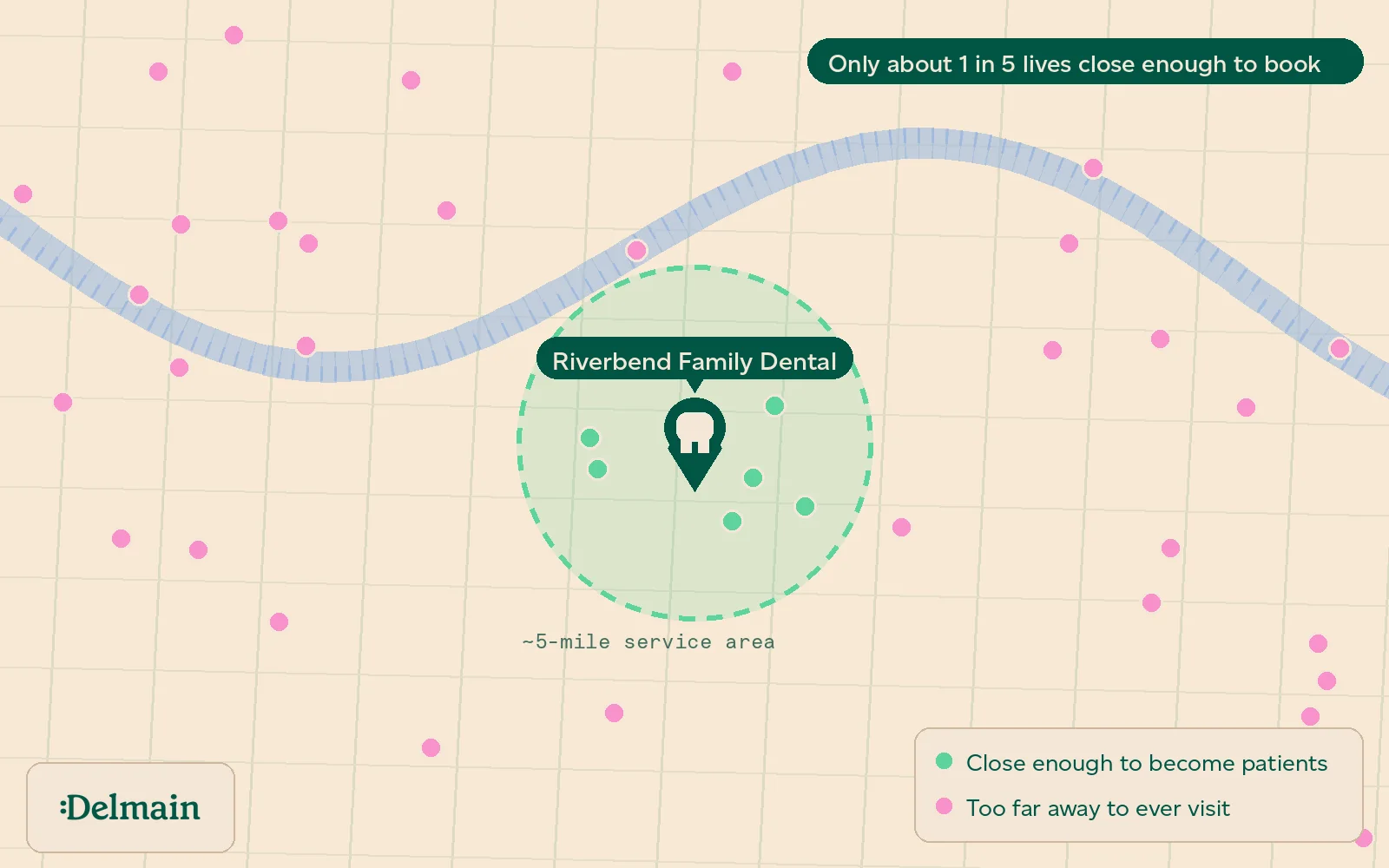
Social followers can still be valuable. But only followers close by are remotely likely to become patients.
The media side (paid ads) is how practices can reliably reach prospective patients in their target market. It’s a more direct way to connect with people before they’re even looking for a dentist.
With Meta Ads, for instance (paid ads on Facebook and Instagram, both owned by Meta), you can restrict visibility of your promotions just to a specific geographic area (by zip code, within a 5-mile radius of your office, or across a specific metro area). So if you’re looking to dental social media marketing as a way to build your patient base, we recommend a greater effort with ads than with organic content.
Case in point: a :Delmain partner success story
One of :Delmain’s partners in rural North Carolina earns 15-20 new patient leads each month through Meta Ads. These leads average around $33 in cost but dipped as low as $13 this year, and they’re all from patients within a radius the practice’s owners can control.
4. Let your goals govern your social media strategy
Both organic content (the social stuff) and paid ads (the media part) will help people learn about your practice. Both are worth time and money. But wherever your practice is on its social media journey, keep in mind that organic and paid content are there for different outcomes and different audiences.
This makes it a lot easier to prioritize your efforts and to measure what you’re getting.
Let’s talk social strategy for your practice
Meet with our team for free ideas on how to grow your practice through social media content and Meta Ads.
Common questions
Does dental social media marketing actually bring in new patients?
It certainly can, though most often through the paid side rather than organic posts. Social algorithms favor content relevance over location, so a large organic following usually includes people who live too far away to ever book. Paid ads let you target a specific zip code or radius, which is why they tend to bring in new patients more reliably.
Should a dental practice focus on organic posts or paid ads?
Both have a role, but they serve different goals. Organic content is best for building community and staying top of mind with current patients. Organic content also helps earn AI citations. Paid ads are better for reaching prospective patients in your area. If your main goal is growing your patient base, put more effort into ads than into organic content.
How much does it cost to get new patients through dental social media ads?
Costs vary by market, but the results can be efficient. One :Delmain partner in rural North Carolina averages around $33 per new patient lead through Meta Ads, with some leads coming in as low as $13. :Delmain partners average $58 per lead through Meta Ads, compared to a $77 industry benchmark.
Why doesn’t my practice get many local followers on social media?
Social platforms show posts based on what a person likes, not where they live, so your dental content competes with every other practice posting similar content. The usual result is followers who live too far away to become patients, or very few followers at all. This is a normal challenge of dental social media marketing. It’s also why location-targeted ads matter more than follower count.
About the Author
Stephen Taylor | Director of Marketing
Stephen has spent over a decade crafting and implementing marketing strategies across industries. His background includes agency and in-house roles across social media, email marketing, SEO, content marketing, CRM, and analytics. He was a two-time judge in the International Content Marketing Awards and frequently writes on the topics of digital marketing, books, and video game music.
Keep Reading

Best & Most Popular Dental Podcasts
Do you want to stay up-to-date on the latest dental industry trends, emerging technologies, methods for efficiently running your practice, and strategies to attract new patients? Dental podcasts offer a convenient way for dentists to stay informed and competitive.

20 Best Orthodontic Websites of 2026 & What They Got Right
Your orthodontic website can and should be your #1 source of new patients. How? By designing an orthodontic site that ranks highly in search engines, communicates what makes your practice unique, and impresses visitors. The best orthodontic websites are also designed to be mobile-first and very easy to navigate.

15 Best Pediatric Dental Websites of 2026 & What They Got Right
Parents have big expectations when entrusting their children with a pediatric dentist. The best way to make a good first impression and win them over? WOW’ing them with a well-designed pediatric website.

The Top 35 Books for Dentists of 2026
In the dynamic world of dentistry, staying informed is crucial. Wondering what books your peers are reading? We’ve got you covered with our list of the 31 best dental books for 2024, all highly recommended by dentists and dental experts.

The Truth About ADA Compliant Websites for Dental Practices in 2022
Here’s the truth — nothing you do to make your dental practice’s website ADA compliant can stop someone from suing you. If someone wants to file an opportunistic lawsuit, they can.

HIPAA Compliance For Dental Websites: Making Sense Of It All
How many emails do you get every week from an expert in HIPAA compliance wanting to sell you their services or a new piece of software? Many sales pitches focus on the fear of what might happen or what could happen if you don’t buy the latest HIPAA compliant solution.

Patients
Book your free intro call
Stop wasting marketing dollars! We’re ready to maximize success across your dental marketing efforts. Get your free consultation on targeting the right patients at the right cost. :Delmain’s plug-and-play marketing system is built for dentists, allowing you to predict, plan, and expand effortlessly.