Facebook & Instagram Ads for Dentists: 2026 Benchmarks & Best Practices
Real Meta ad data from 47 dental practices: what Facebook and Instagram ads cost dentists in 2026, cost per lead, and what actually works to win new patient leads.
- 8 min read
- Aug 2026
-
 :Delmain Team
If marketing feels like a mystery, it’s helpful to ask: where does your audience get information? Where do they connect with people they trust? Where do they spend time and money? These are places marketing is already happening. They’re the places your practice should show up.
For a huge share of dental patients, social media is the answer to these questions. This is why Facebook and Instagram ads for dentists still work well today, regardless of newer ways for patients to find your practice. If you’re deciding where to put your effort, here’s how organic and paid social fit together.
There’s more happening than idle scrolling. People are actively looking for things that make their lives better, including a dentist they can trust.
This post breaks down what Facebook and Instagram ads (Meta Ads) actually cost a dental practice in 2026. We’ll share real :Delmain client data, not the recycled cross-industry averages you’ll find everywhere else. Read on for a handful of things that separate the cheap-lead accounts from the expensive ones.
Would you say no to more patients?
Call us for a free audit of your advertising. We’ll share insights specific to your practice, your market, and your ads performance.
Why social media still deserves your ad budget
About half of all Americans visited a Meta platform daily last year. Even as more people start their searches with AI tools, social platforms keep audiences engaged in a way search never has.
Google answers a question and sends someone away. Facebook and Instagram keep them close, which gives a well-made dental ad repeated chances to show up, build familiarity, and catch someone at the moment they finally decide to book. That combination of massive attention and buying intent is exactly why Meta Ads still earn their place next to (not instead of) your Google Ads and other dental marketing.
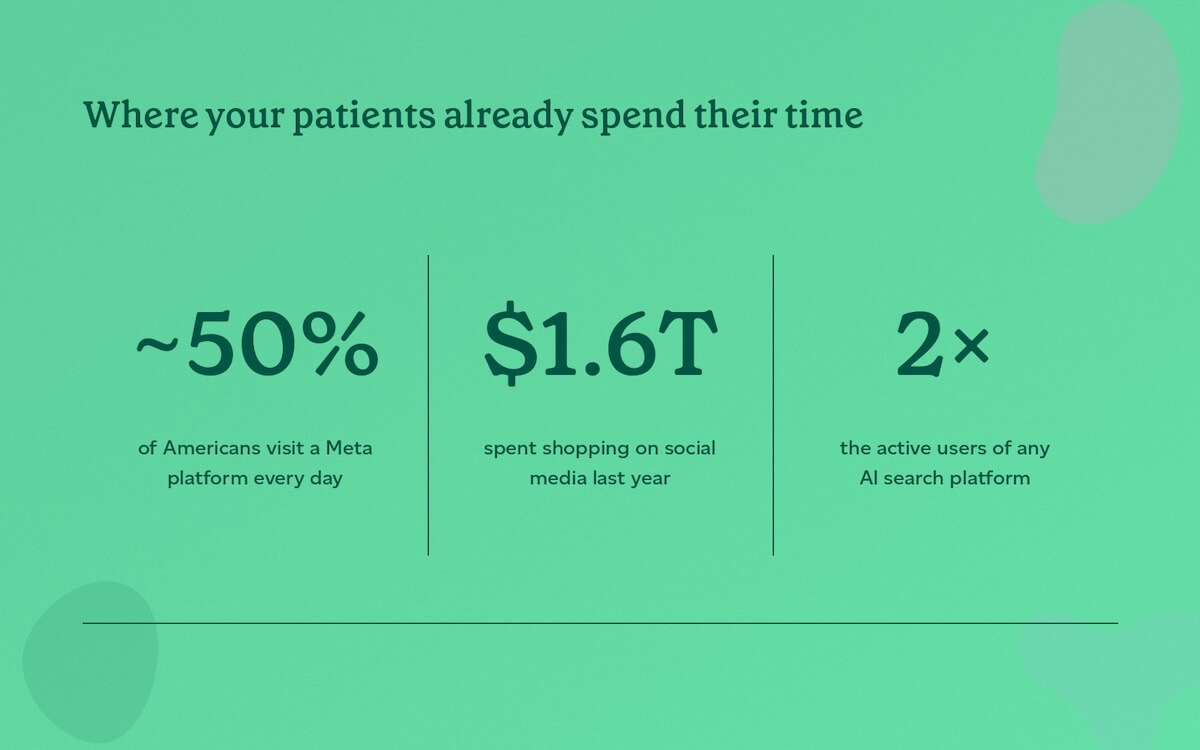
People spend more than just time on social media. Shopping on social media crossed $1.6 trillion last year, and it’s not slowing down.
It’s clear that social media is good for more than just information. People make financial decisions without leaving the platform.
Case in point: a :Delmain partner success story
One of our partners in Houston, TX averaged more than 20 patient leads per month from Meta Ads. We launched a new campaign for them last month that drove just as many leads in only 8 days at less than $10 per lead.
2026 Meta Ads benchmarks for dentists
Here’s what the numbers look like across 47 :Delmain practices running Meta Ads right now.
A few plain-language definitions first: CPM is what you pay per 1,000 times your ad is shown, cost-per-click is what you pay each time someone taps your ad, and click-through rate (CTR) is how often people who see the ad actually click it.
| Metric | :Delmain dental practices | Typical industry benchmark |
|---|---|---|
| Cost per 1,000 views (CPM) | $15.68 | ~$18–$30 |
| Cost per click (CPC) | $0.51 | ~$1.90 (lead campaigns) |
| Cost per link click | $0.61 | $1.70 |
| Click-through rate (CTR) | 3.06% | ~1.2%–2.8% |
| Cost per landing-page view | ~$1.61 | — |
| Cost per qualified lead (call or form) | ~$58 (best: ~$30) | ~$77 (dentists) |
| Monthly ad spend per practice | ~$334 median ($300–$1,000 typical) | — |
The top-of-funnel story is the clearest. Clicks at about 51 cents and a 3%+ click-through rate mean these ads are getting affordable, frequent attention well ahead of the industry norms, where dental clicks routinely run several dollars. You don’t need a big budget to see this, either. The median practice spends around $334 a month.
Digging deeper, we saw that a tracked phone call or form submission from Facebook and Instagram cost about $58. The accounts with the highest engagement brought patients in for closer to $30. For comparison, the advertising industry’s own benchmarks put a dentist’s Facebook lead at roughly $77. So the practices doing this well are paying a fraction of what normal looks like.
The number Meta won’t show you: calls, not leads
Here’s a key element to understand with ads on Facebook and Instagram. If you open Facebook Ads Manager and look at the Leads column, you’ll sometimes see zero and conclude the ads don’t work. We’ve seen this for numerous practices in this data set: Meta’s native leads number shows 0.
It’s not actually an ad failure. It’s a measurement gap. In our experience, the majority of dental patients don’t fill out lead forms. They call, even when Meta Ads gave them a way to book online. Those calls are real, qualified leads, but they happen off-platform, so Meta doesn’t count them by default.
Look at how your ad performance is measured to get a clearer sense of what’s working and what’s not.
For instance
Across :Delmain’s six highest-spend practices, call tracking caught 830 phone calls driven by Meta Ads that Facebook’s own dashboard hadn’t logged.
This is the most common reason dentists wrongly write off Facebook. Attribution (ensuring your ads really drive results) is almost always more complex than what Meta Ads naturally tracks.
If you’re only watching the in-platform numbers, you’re likely missing most of what your ads produce. One clear fix is call tracking (a tool like CallRail) that tags each call with its source, so a Facebook-driven call gets counted as a Facebook result.
Best practices for Meta Ads in dentistry: what separates the cheap-lead accounts
The practices getting leads near $30 instead of $100 tend to do the same handful of things.
Optimize for the action that matters: calls and bookings, not just clicks. Campaigns pointed at traffic earn cheap clicks that go nowhere. Campaigns built around calls and appointment requests get you patients. For instance, :Delmain’s team prioritizes link clicks (clicks more likely to generate bookings) above general clicks on the content of an ad.
Give the machine learning room to work. At its core, Meta’s ad system is a bidding and targeting engine. It learns who converts over time. Boxing it into a tiny, over-filtered audience starves it of the information it needs to be effective. The strong click and CTR numbers above come from letting the system find in-market patients over the course of enough time. Campaigns also drive bigger wins when they feed Meta clear signals about which clicks become calls and booked appointments.
Lead with creative that looks like social content, not a corporate pitch. The feed rewards content that users actually enjoy coming across. Feature your real team, your real office, and even real patients to make this more authentic. Also, short video handily outperforms stock photography. Creative is almost always what wins a high CTR (like the 3% figure above).
Run an offer with a reason to act now. We often see success with practices promoting new-patient exams, whitening with a cleaning, or limited-time implant consults. A concrete offer does a lot more to stop the scroll and convert visitors into patients.
Retarget the people who’ve already engaged. It doesn’t cost much to reach previous website visitors and video viewers, and they’re a lot more likely to book an appointment. This is where a chunk of the low-cost leads come from.
Meta Ads can work for your dental practice
You might hear more in the news about new AI platforms than about Facebook. But Facebook still has twice as many active users as any AI platform. Don’t overlook Meta Ads if you’re ready to grow your practice.
Your next patient is already scrolling on a Meta platform. The question is whether they’ll find you there.
Try Meta Ads for your practice
Meet with our team for free ideas on how to grow your practice through Meta Ads.
Our methodology
Figures reflect :Delmain-managed Meta ad accounts (Facebook + Instagram) for dental practices from July 2025 to July 2026. We aggregated reach and cost benchmarks (CPM, CPC, CTR, cost per landing-page view, monthly spend) across 47 practices.
A qualified lead is defined as a tracked phone call or form submission attributed to a Meta campaign, with calls attributed by last-touch source in CallRail. Because some form submissions route through third-party booking tools that Meta doesn’t record, the true qualified-lead count is likely higher (and the real cost per lead somewhat lower) than reported.
Common questions
How much do Facebook ads cost for a dental practice?
Most :Delmain dental practices spend between $300 and $1,000 a month on Meta Ads, with a median around $334. That buys clicks at about 51 cents and qualified leads (calls or forms) at roughly $58 on average.
What’s a good cost per lead for dental Facebook ads?
Industry benchmarks put a dentist’s Facebook lead near $77. Anything meaningfully below that is strong; the top-performing dental accounts in this data reached about $30 per qualified lead. The key is measuring calls, not just in-platform form leads.
Why does Facebook say my ads got zero leads?
We sometimes see Facebook reporting zero leads because dental patients called instead of filling out a form that Meta could track directly. Those calls are real leads. We strongly recommend using call tracking to attribute them back to the ad that drove them.
Should dentists use Facebook ads or Google Ads?
We recommend both for different jobs. Google captures people already searching for a dentist; Facebook and Instagram build awareness and demand where patients spend their time, often at a lower cost per click. Together they cover the full path from “not looking yet” to “booking now.”
About the Author
Stephen Taylor | Director of Marketing
Stephen has spent over a decade crafting and implementing marketing strategies across industries. His background includes agency and in-house roles across social media, email marketing, SEO, content marketing, CRM, and analytics. He was a two-time judge in the International Content Marketing Awards and frequently writes on the topics of digital marketing, books, and video game music.
Keep Reading

Best & Most Popular Dental Podcasts
Do you want to stay up-to-date on the latest dental industry trends, emerging technologies, methods for efficiently running your practice, and strategies to attract new patients? Dental podcasts offer a convenient way for dentists to stay informed and competitive.

20 Best Orthodontic Websites of 2026 & What They Got Right
Your orthodontic website can and should be your #1 source of new patients. How? By designing an orthodontic site that ranks highly in search engines, communicates what makes your practice unique, and impresses visitors. The best orthodontic websites are also designed to be mobile-first and very easy to navigate.

15 Best Pediatric Dental Websites of 2026 & What They Got Right
Parents have big expectations when entrusting their children with a pediatric dentist. The best way to make a good first impression and win them over? WOW’ing them with a well-designed pediatric website.

The Top 35 Books for Dentists of 2026
In the dynamic world of dentistry, staying informed is crucial. Wondering what books your peers are reading? We’ve got you covered with our list of the 31 best dental books for 2024, all highly recommended by dentists and dental experts.

The Truth About ADA Compliant Websites for Dental Practices in 2022
Here’s the truth — nothing you do to make your dental practice’s website ADA compliant can stop someone from suing you. If someone wants to file an opportunistic lawsuit, they can.

HIPAA Compliance For Dental Websites: Making Sense Of It All
How many emails do you get every week from an expert in HIPAA compliance wanting to sell you their services or a new piece of software? Many sales pitches focus on the fear of what might happen or what could happen if you don’t buy the latest HIPAA compliant solution.

Patients
Book your free intro call