Reviews for Dentists: Let Your Patients Tell the Story You Can’t
Reviews for dentists are worth more than a star rating. Your patients have already written the best copy on your website, and this post is about finding it and putting it where the next nervous patient can see it.
- 10 min read
- Sep 2026
-
 :Delmain Team
In this article
Think about the last big thing you bought. A hotel for a conference, a stand mixer, maybe a new handpiece. Chances are you went straight to the reviews before you made a purchase. You probably skipped the “great service” ones and read the longer ones from the people whose situation sounded like yours.
You already knew what the seller would say, but wanted to hear from someone with nothing to sell. Reviews for dentists work the same way.
Key points in this article
- A patient can say things about your practice that you can’t say about yourself, and research shows readers believe those things more when they come from someone else.
- Reviews persuade most when the reader is unsure and the reviewer sounds like them. That describes many people looking for a dentist.
- Five :Delmain partners show how to use patient words as stories, as page content, and in ads.
How do patients choose a dentist online?
Choosing someone to trust with their smile is a big decision, and most patients start with the reviews. 73% of patients consider online reviews when choosing a healthcare provider, dentists included.
So it’s 11 pm on a Tuesday, and someone a few miles from your practice has two tabs open. The first tab says “gentle, caring team.” The second shows a stranger’s words from a review: “I walked in the door with a toothache. I’ve never felt more comfortable than with the people who work there.”
Which practice gets the call in the morning?
As a content strategist, I choose the patient reviews that go on our partners’ websites, so I read a lot of them. The lines that stop me are ones no dentist would write about themselves. “You feel like you just left Nordstrom!” is one real example.
The short answer
Reviews for dentists work because a patient will believe a stranger before they believe an ad. A review shows what your practice is like, from someone who has no reason to flatter you. Research on persuasion shows praise from a third party lands harder than the same praise from yourself, and that social proof works best on people who feel unsure, from people who sound like them. The practices that get the most out of their reviews treat them as the story of the practice, told by the people who lived it.
Dentists do this with big decisions, too. When Timberhill Dental first came to :Delmain, its owner at the time found us by reading what other dentists had written about us.
Your brand is the story other people tell
When we say “branding,” most people picture logos and colors, but a big part of it is the story other people tell about your practice. You can decide you stand for calm, modern care and say so on your website. Patients will build their own version anyway, first out of what other patients told them, and second out of what they go on to experience (and share) themselves.
Social proof is where your version and your patients’ meet. Every review you choose to feature shapes what a future patient reads first. This makes picking reviews a branding decision as much as a marketing one.
“Don’t take our word for it” — the psychology of social proof
Social proof does work your own copy can’t do, and there’s psychology behind why.
We covered this in Where it Pays (or Costs) for Dental Practices to Stand Out: your website probably says your team is gentle and your office is up to date, and these are likely true. The thing is, a new patient has no way to check. They’ve read the same words on a dozen sites that night, so the words carry less weight, even when they’re true.
In 2006, Stanford’s Jeffrey Pfeffer and Robert Cialdini, the psychologist behind the seven principles of persuasion, ran a series of experiments on self-promotion. People heard the same praise about a professional, either from the professional themselves or from a third party. The third-party version made the professional seem more likeable and more competent. It kept working even when listeners knew the third party was paid to say it.
Pfeffer’s conclusion: a third party “can say things that you could never say about yourself.”
A patient review is that third party, and it costs nothing. Compare two lines about the same practice:
- The website: “We make every visit as comfortable as possible.”
- A patient: “I was so relaxed I nearly fell asleep during one of my fillings.”
The first is a claim, but the second is a scene. A reader can picture it, and they can tell a dentist didn’t write it. Another patient at the same practice wrote, “I sure hit the jackpot by having Jackie as my hygienist.” No practice would put that on its homepage, and that’s the point. The candor is proof the words are real.
Are patients finding another practice before yours?
Let’s make yours the obvious choice.
Do online reviews change where patients book?
Yes, and a lot more than most practices expect.
- 75% won’t book a provider rated below 4.0 stars, and 44% won’t book below 4.5, per a survey of 992 US patients.
- 55% have walked away from a provider because of what they read in reviews. That’s up from 40% the year before.
- 51% won’t choose a provider with no reviews at all. Two in five also treat a review older than a year or two as out of date.
So you need a good rating to be in the running. But a perfect one can work against you. Northwestern’s Spiegel Research Center found that purchase likelihood peaks between 4.0 and 4.7 stars and drops as ratings approach a perfect 5.0, because a flawless score starts to look staged.
“I’ve had a lot of anxiety around dental work”
“They got me in within an hour and had me done and out the door within 90 minutes. Dr. Whalen was absolutely fantastic! I’ve had a lot of anxiety around dental work, and he was very kind, explained everything, and worked quickly!”
— Crystal, Grande Dunes Dental patient
Dental social proof, the idea that a patient trusts other patients over the practice itself, rests on the best-known of Cialdini’s principles. In Influence, he says it’s strongest for people who feel “unfamiliar or unsure,” and when the people we’re watching seem “similar to ourselves.”
Most new dental patients fit that description. In a JADA survey of 1,003 US adults, 72.6% said they have some fear of the dentist. Nervous patients often need to hear from someone who felt the same way and came out okay.
This is why, when we build a service page, we don’t always choose the most recent reviews. We pull the ones that name the fear or problem the page addresses. A sedation page needs that patient who admits their nerves were bad but ended up surprised at how easy it all was. An implants page needs the testimonial from that person who put it off for years and is now happy with their new smile. Short, general reviews don’t let a reader see themselves in the situation.
What counts as dental social proof?
Anything that puts the patient front and center of your practice’s story. On a dental website, it usually takes one of these forms:
- A Google review. The shortest version: one scene, in the patient’s words, on a platform you don’t control.
- A testimonial on your site. A review you choose and place where it answers the question a reader has on that page.
- A before-and-after. The ending, shown instead of told. It works with your own photos.
- A patient video. The whole story in the patient’s own voice, showing their face. Hardest to get, but hardest to doubt.
- A case study. A before-and-after with the reasoning in between: what the patient came in with, what you chose, and why.
- Your review count and rating. Meadowmont’s homepage puts it in one line: “4.9 stars, based on nearly 800 Google reviews.” That tells the reader there’ve been hundreds of patients before them, and almost all of them were happy. But if your rating drops below 4.0, three out of four patients won’t book.
- Your replies. The part of the story you write yourself. Patients prefer a provider who replies to reviews. A calm reply to a negative review tells the next patient how you’d treat them if something went wrong.
Five ways our partners let patients tell the story
1. Tell one patient’s whole story.
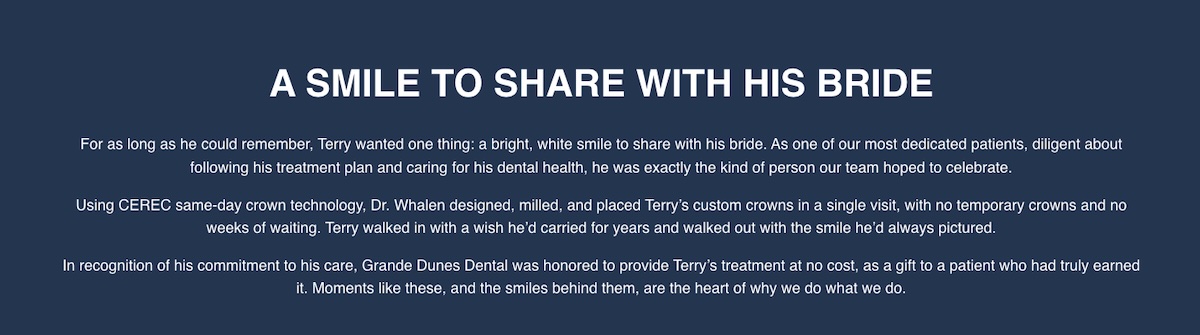
On Grande Dunes Dental’s same-day crowns page, there’s a short story about a longtime patient who wanted a bright smile in time for his wedding. Dr. Whalen designed and placed his crowns in one visit, and the practice covered the treatment as a gift. Research on narrative persuasion shows people argue back less when they’re inside a story than when they’re reading a claim. The reviews section on the same site is headed “This is why we do it,” which turns a widget into a reason.
2. Organize the testimonials page like a story.
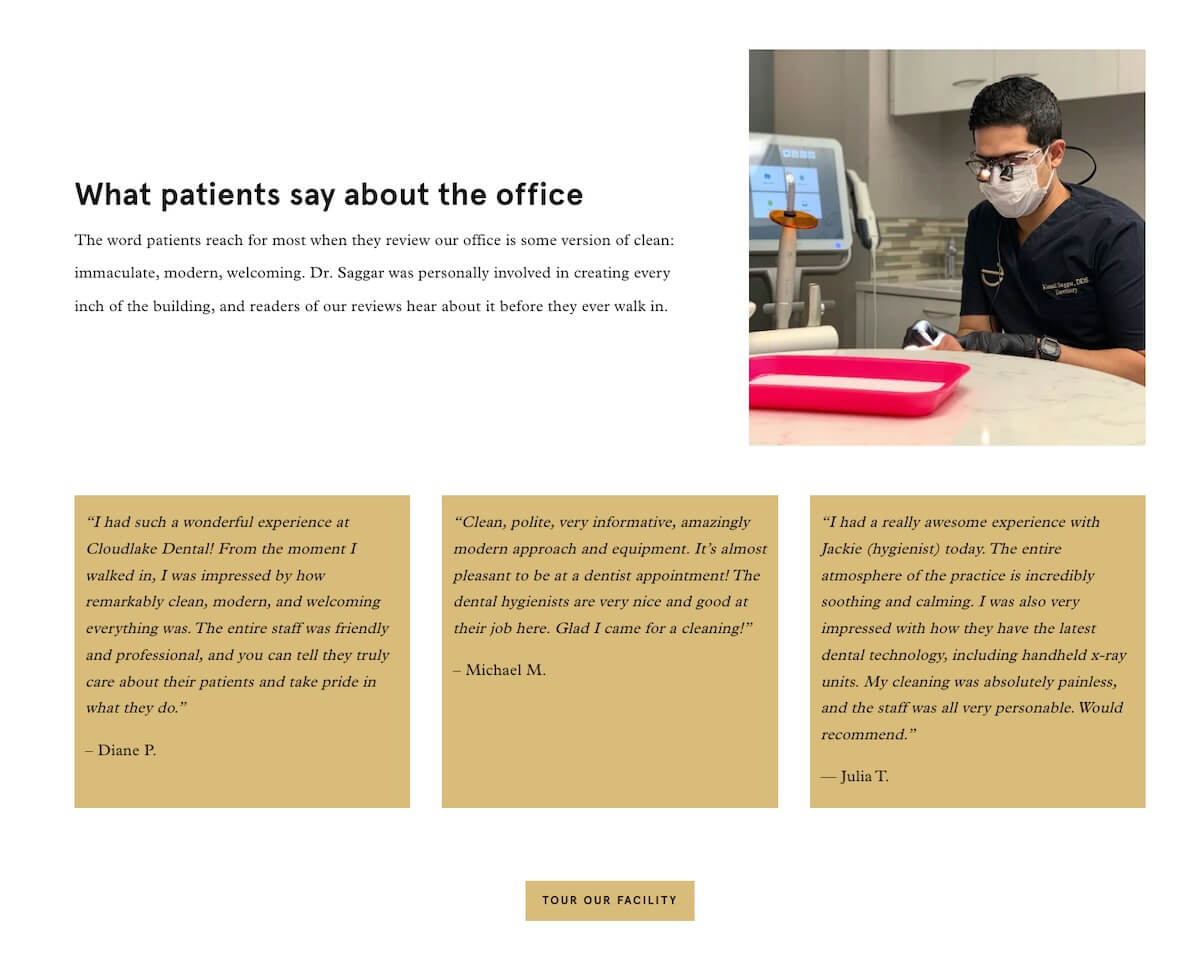
Cloudlake Dental’s testimonials page isn’t a wall of quotes but four short chapters: patient stories on camera, what patients say about Dr. Saggar, what they say about the office, and first visits in their own words. A nervous reader can skip to the part that answers their question. The same patient narrative runs through their Meta ads, one of which reads “5.0 star calm. See why we have earned over 700 five-star reviews.”
3. Match the narrator to the reader.
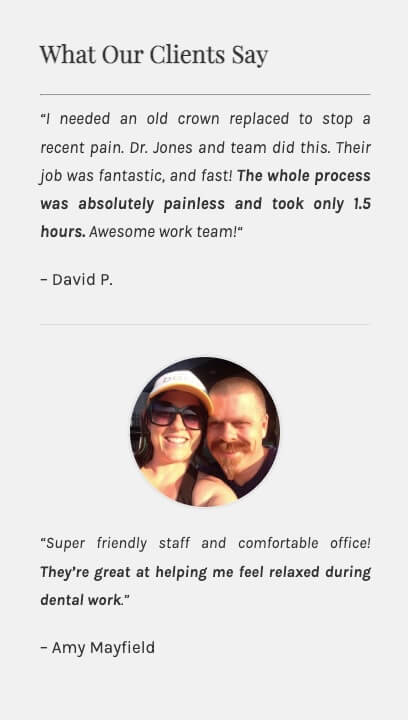
Timberhill Dental had one general testimonial repeating across service pages. We recently replaced it page by page. The implants page now carries a patient describing restorative work that was “absolutely painless and took only 1.5 hours.” It’s the similarity principle from above: the closer the reviewer’s situation is to the reader’s, the more it persuades. Timberhill went from 12 to 80+ new patients a month with :Delmain.
4. Show the ending first.
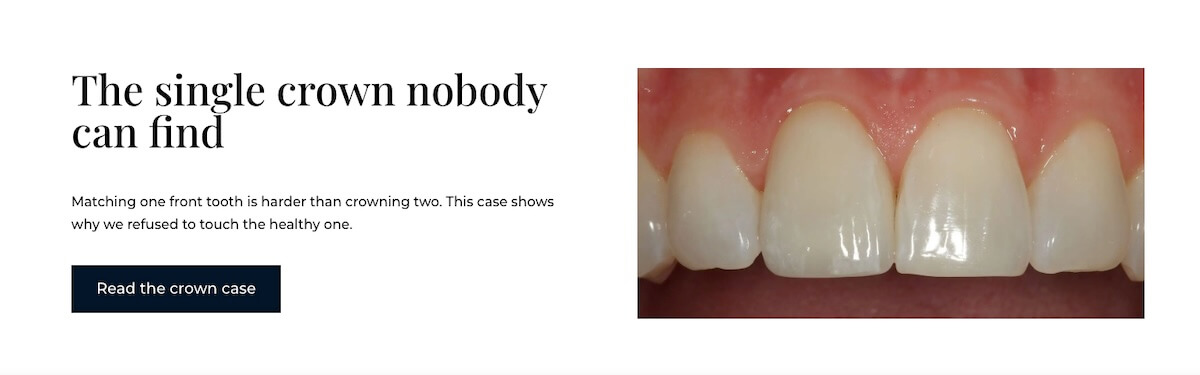
Paul Mundl, DDS, is an accredited cosmetic dentist, and his Patient Showcase page treats each case like a short story with a title: “The single crown nobody can find,” “Four veneers instead of eight.” A few lines explain what the patient came in with and why he chose the conservative option, next to before-and-after photos. No quotes, but the same effect. A potential veneers patient sees someone like them and the outcome they’d want for themselves.
5. Keep the story current.
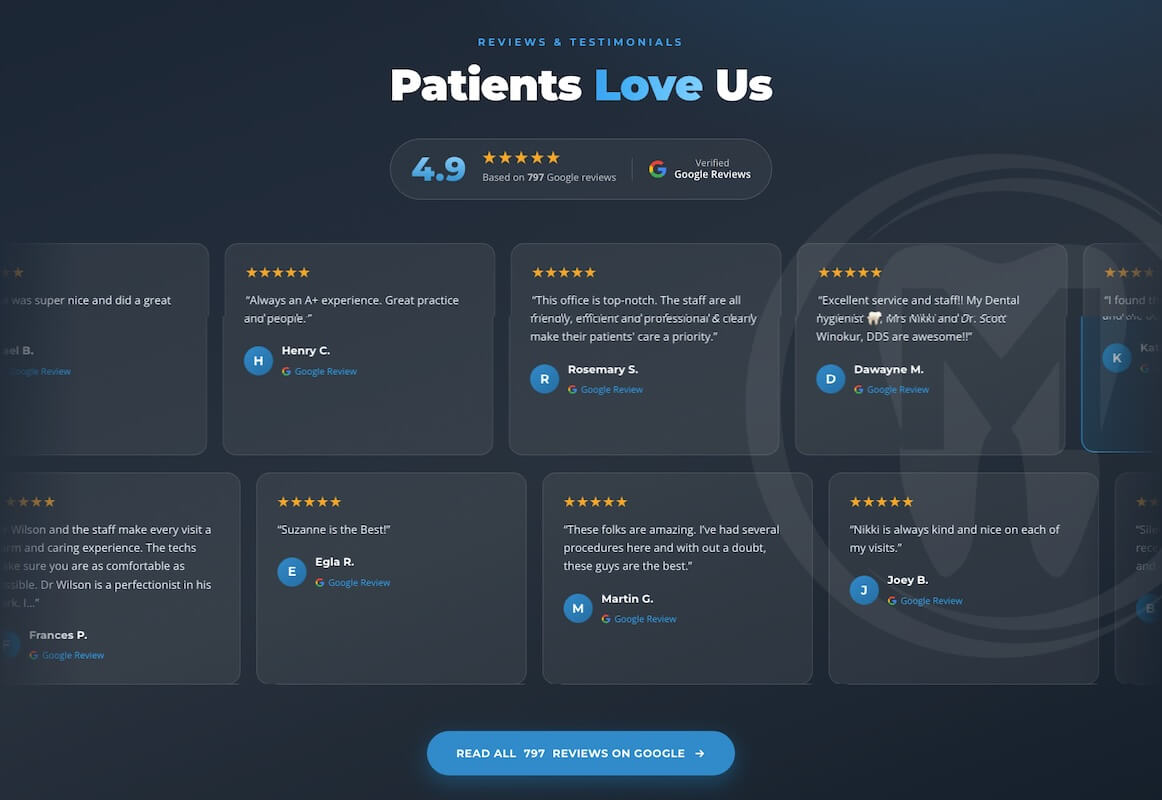
Meadowmont Dentistry’s reviews section pulls their newest five-star Google reviews automatically, in the site’s own design. A testimonials section that was pasted in at launch ages fast, and patients notice.
Get the next Word of Mouth post in your inbox.
The takeaway
Somewhere in your Google profile is a patient who wrote about being afraid or putting off treatment. Find those lines and put them where the next patient will see them.
And if you don’t have it yet, ask! The patient who came back after ten years away, or whose smile you rebuilt after years of feeling insecure, would probably be glad to tell that story. Many wouldn’t consider doing it unprompted, but 68% would leave a review if asked.
Patient reviews are free, and they will do more for your practice than anything you could write about yourself.
Three out of four patients won’t book a practice they can’t trust online.
Book a free strategy call and find out what yours is telling them.
Common questions about reviews for dentists
What star rating does a dental practice need?
Most patients won’t look twice at anything under 4.0. Below that, you lose three-quarters of prospective patients outright. Having no reviews is worse than a modest rating: half of patients wouldn’t choose a provider with no reviews at all.
Does dental social proof help with SEO?
Indirectly, yes. Google says more reviews and higher ratings can help your local ranking, and review count is part of how it measures a practice’s prominence. The testimonials on your website probably won’t help you rank, but they can help a visitor decide to book.
Can we edit a patient's review before featuring it?
Yes, but do it lightly. Fix punctuation, trim length, and use a first name and last initial. Don’t change the meaning, and don’t combine two reviews into one. If a review would need heavy editing to work, just pick a different one. The value of a review is that a patient wrote it.
Should we show reviews that aren't five stars?
On your website, feature the five-star ones. On Google, take the time to reply to them. A profile that’s all perfect scores can look staged, and 66% of patients say replies affect how much they trust a practice.
About the Author
Paula Obeso | Content Strategist
Paula Obeso is a content strategist at :Delmain, where she decides what belongs on a dental practice’s website and why. She balances optimization and strategy with creativity, connecting what patients look for with what a practice offers. Her background is in creative copywriting and strategic advertising.
Keep Reading

Best & Most Popular Dental Podcasts
Do you want to stay up-to-date on the latest dental industry trends, emerging technologies, methods for efficiently running your practice, and strategies to attract new patients? Dental podcasts offer a convenient way for dentists to stay informed and competitive.

20 Best Orthodontic Websites of 2026 & What They Got Right
Your orthodontic website can and should be your #1 source of new patients. How? By designing an orthodontic site that ranks highly in search engines, communicates what makes your practice unique, and impresses visitors. The best orthodontic websites are also designed to be mobile-first and very easy to navigate.

15 Best Pediatric Dental Websites of 2026 & What They Got Right
Parents have big expectations when entrusting their children with a pediatric dentist. The best way to make a good first impression and win them over? WOW’ing them with a well-designed pediatric website.

The Top 35 Books for Dentists of 2026
In the dynamic world of dentistry, staying informed is crucial. Wondering what books your peers are reading? We’ve got you covered with our list of the 31 best dental books for 2024, all highly recommended by dentists and dental experts.

The Truth About ADA Compliant Websites for Dental Practices in 2022
Here’s the truth — nothing you do to make your dental practice’s website ADA compliant can stop someone from suing you. If someone wants to file an opportunistic lawsuit, they can.

HIPAA Compliance For Dental Websites: Making Sense Of It All
How many emails do you get every week from an expert in HIPAA compliance wanting to sell you their services or a new piece of software? Many sales pitches focus on the fear of what might happen or what could happen if you don’t buy the latest HIPAA compliant solution.

Patients
Book your free intro call
Stop wasting marketing dollars! We’re ready to maximize success across your dental marketing efforts. Get your free consultation on targeting the right patients at the right cost. :Delmain’s plug-and-play marketing system is built for dentists, allowing you to predict, plan, and expand effortlessly.