Answer Engine Optimization for Dentists: How to Get Cited by AI Search
AEO, GEO, WhateverYouWannaCallItEO. It’s here to stay, and it’s changing how patients find their next dental appointment. Here’s how to make sure the AI answers send them to you.
- 13 min read
- Jul 2026
-
 Hannah Moen
Key points in this article
- Patients now use AI tools like Google’s AI Overviews, ChatGPT, and Perplexity to research dental care before they ever call a practice.
- More than 40 million people ask ChatGPT health questions every day, and 89% of healthcare searches now trigger an AI Overview on Google.
- Answer engine optimization (AEO) is the work of getting your practice named and cited inside those AI answers, where a growing share of patients stop reading.
- AI tools pull from a short list of sources you control: your website, your business listings, and your reviews. You can’t buy your way in.
- Six steps get you cited: answer real patient questions, put the answer first, add schema markup, keep every listing consistent, grow reviews, and show your credentials.
- We can help. :Delmain tracks AI citations and share of voice for every SEO partner, so you’ll know it’s working.
A patient with a cracked crown used to type “emergency dentist near me” into Google and call the first practice with strong reviews. Today, many of them open ChatGPT instead and ask, “Which dentist near me can fix a cracked crown, and what will it cost?” The AI responds with a short answer and a few practice names. If yours is one of them, you get the call.
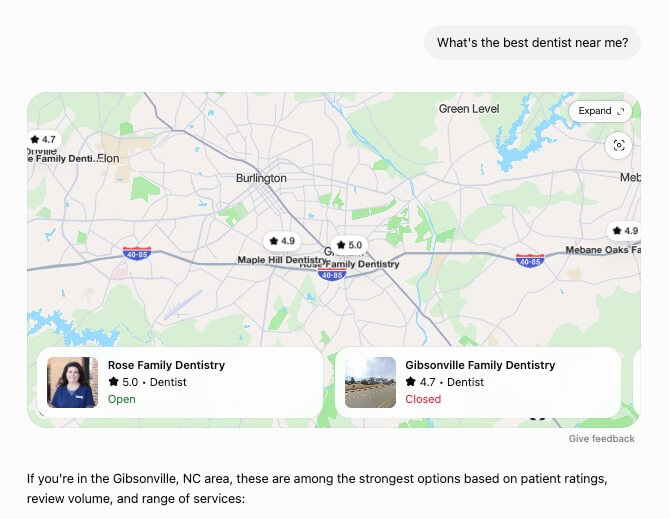
Getting named in those answers is what answer engine optimization (AEO) is all about. In this guide, we’ll cover how patients are using AI to research dental care, where tools like ChatGPT and Google’s AI Overviews pull their answers from, and the six steps that make your practice the one they cite.
What is answer engine optimization?
Answer engine optimization is the work of making your practice the answer AI tools give. When a patient asks ChatGPT, Google, or Perplexity a question about dental care, those tools scan trusted sources, assemble a direct answer, and cite where the information came from. AEO makes your website one of those sources.
You may also hear this called generative engine optimization (GEO) or AI SEO. All three names describe the same goal: show up inside the answer itself, since many patients never scroll past it.
AEO builds on the search engine optimization you already know. AI tools lean heavily on the same signals Google has always rewarded: helpful content, accurate business information, good reviews, and a site that’s easy to read. If you have a solid SEO foundation, you’re closer to AI visibility than you might think. Our dental SEO guide covers that foundation step by step.
Are patients finding another practice before yours?
Let’s make yours the obvious choice.
Patients are already asking AI about their teeth
This shift is measurable, and it’s moving fast.
- More than 40 million people ask ChatGPT health questions every day, according to OpenAI’s “AI as a Healthcare Ally” report from January 2026.
- In an OpenAI survey from December 2025, 3 in 5 US adults said they had used AI tools for health questions in the past three months.
- Gallup polling from late 2025 found that 25% of Americans have used an AI tool or chatbot for health information, and 59% of those users research their concerns before a visit.
- BrightEdge found that 89% of the healthcare searches it tracks now trigger an AI Overview at the top of Google, up from 59% in December 2023.
Think about what that means for a dental practice. Before a patient ever searches your name, they’ve likely asked an AI whether their symptom is urgent, what treatment usually costs, and whether insurance tends to cover it. The practices cited in those answers earn trust before the first phone call.
There is one exception. Google has pulled AI Overviews back from “dentist near me” style searches, where the familiar map results still decide who gets seen. The AI answers dominate every step before that moment, which is the research phase where patients decide what they need and who sounds credible. AEO wins the research phase. Local SEO still wins the booking phase, and you need both.
See it in action:
Earlier this month, a new patient told one of our partners, an orthodontist in Alabama, that they chose the practice after ChatGPT recommended it. We only know because we’d added “AI / ChatGPT” as a lead source on the practice’s intake forms. If you aren’t asking patients how they found you, start there.
Where AI tools get their answers
Each AI tool assembles answers a little differently, and they all rely on the same short list of sources:
- Your website. AI Overviews and ChatGPT both quote and cite practice websites that answer questions clearly. This is the source you control completely.
- Search indexes. Google’s AI features draw on Google’s index. ChatGPT leans on Bing’s index when it searches the web. If your site has technical problems that keep either one from reading your pages, AI tools can’t cite you.
- Business listings and directories. For local recommendations, AI tools cross-check your Google Business Profile, Bing Places, Apple Maps, Yelp, and other directories. Conflicting hours, addresses, or phone numbers make them less confident naming you.
- Reviews. Volume, rating, recency, and the words patients use in reviews all shape whether an AI recommends your practice.
Notice what’s absent from that list: advertising. Today, you can’t pay your way into an AI answer. The practices that get cited earned it with accurate, consistent, useful information.
How to get cited: 6 steps
We covered what an AI-optimized dental website looks like in an earlier post. These six steps are how we put that thinking into practice for our partners.
1. Answer the questions patients actually ask
AI tools respond to full questions, so your content should be built around them. Pull questions from the front desk, patient emails, and the “People also ask” boxes in Google results. Then give each important question its own heading and answer, on your service pages and in a real FAQ section. Write the way your patients talk, since that’s exactly how they phrase things to ChatGPT.
Why it matters: “How much does a dental implant cost without insurance?” will earn citations that a page titled “Implant Dentistry Services” never will.
See it in action: A service page FAQ block where each question expands to a short, direct answer. Easy for patients to scan, easy for AI to lift.
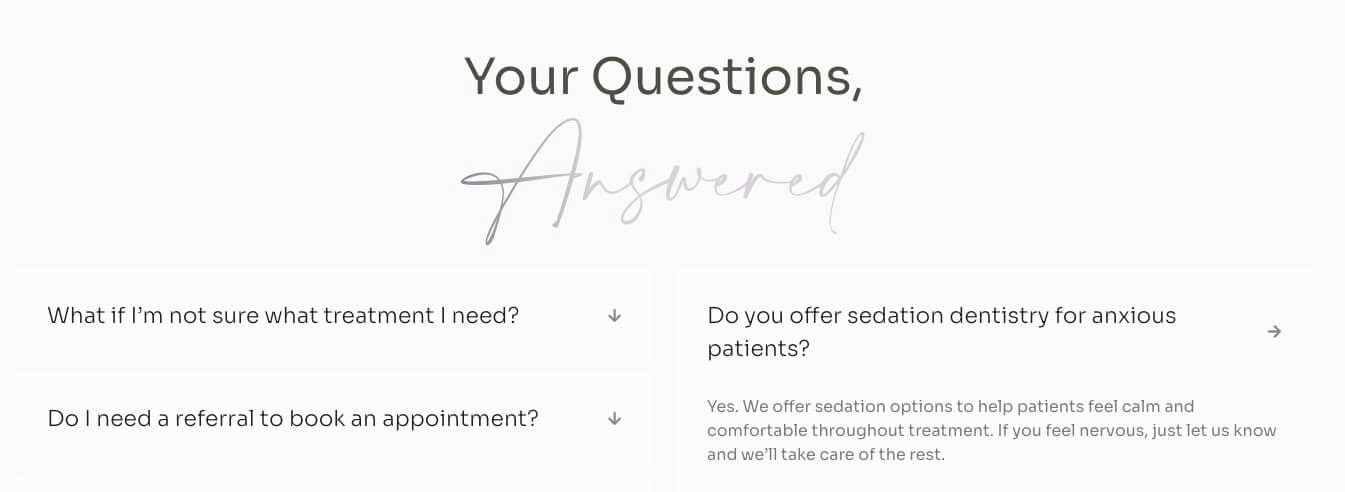
In the past month alone, our partners were recommended in Google’s AI Overviews for searches like “sensitive teeth dentist near me” (a dentist in Wheaton, Illinois), “dental Botox near me” (a dentist in South Florida), “premier dentist near me” (a family practice in Ontario), and “emergency dentist for kids near me” (a pediatric practice). Every one of those citations started with a page that answered the question in plain language.
2. Put the answer first
AI tools lift short, direct passages. Under each question heading, answer in the first two or three sentences, then add the detail. Short sections, descriptive headings, and bulleted lists all make it easier for an AI to find and quote your answer.
Why it matters: If a patient asks “how long does a root canal take,” the page that opens with “Most root canals take 60 to 90 minutes” is the one that gets cited.
See it in action: A blog headline that mirrors the patient’s question, with a concise answer in the content following.
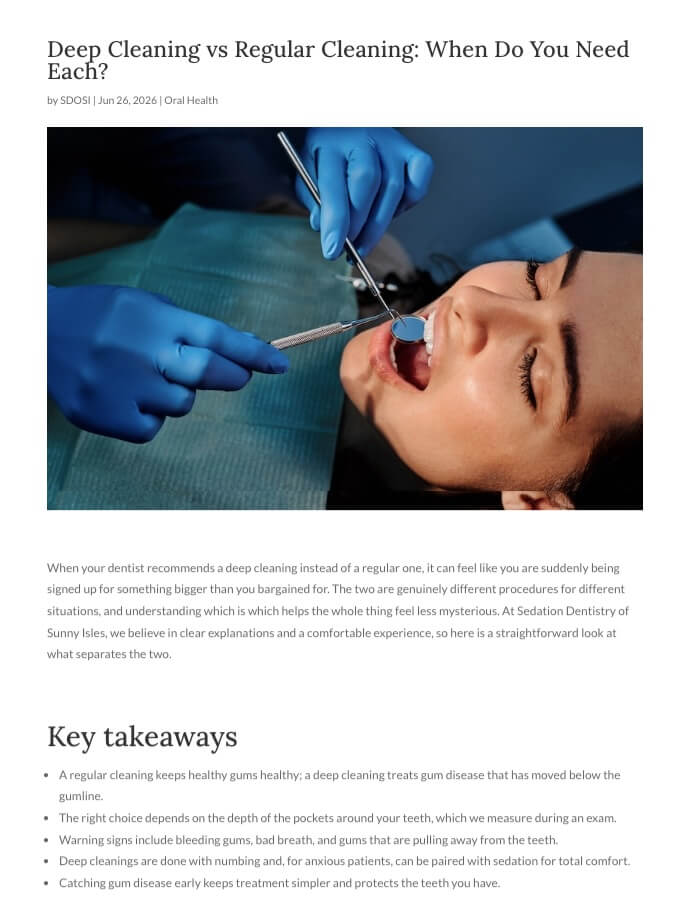
One of our partners, a multi-location emergency dental practice in Indiana, ranks first in Google’s AI Overview for emergency dentist searches in one of its markets, with citations across five markets in total. From January through May, the location page behind that top citation generated 320 phone calls from organic search, 193 of them first-time callers.
3. Add schema markup
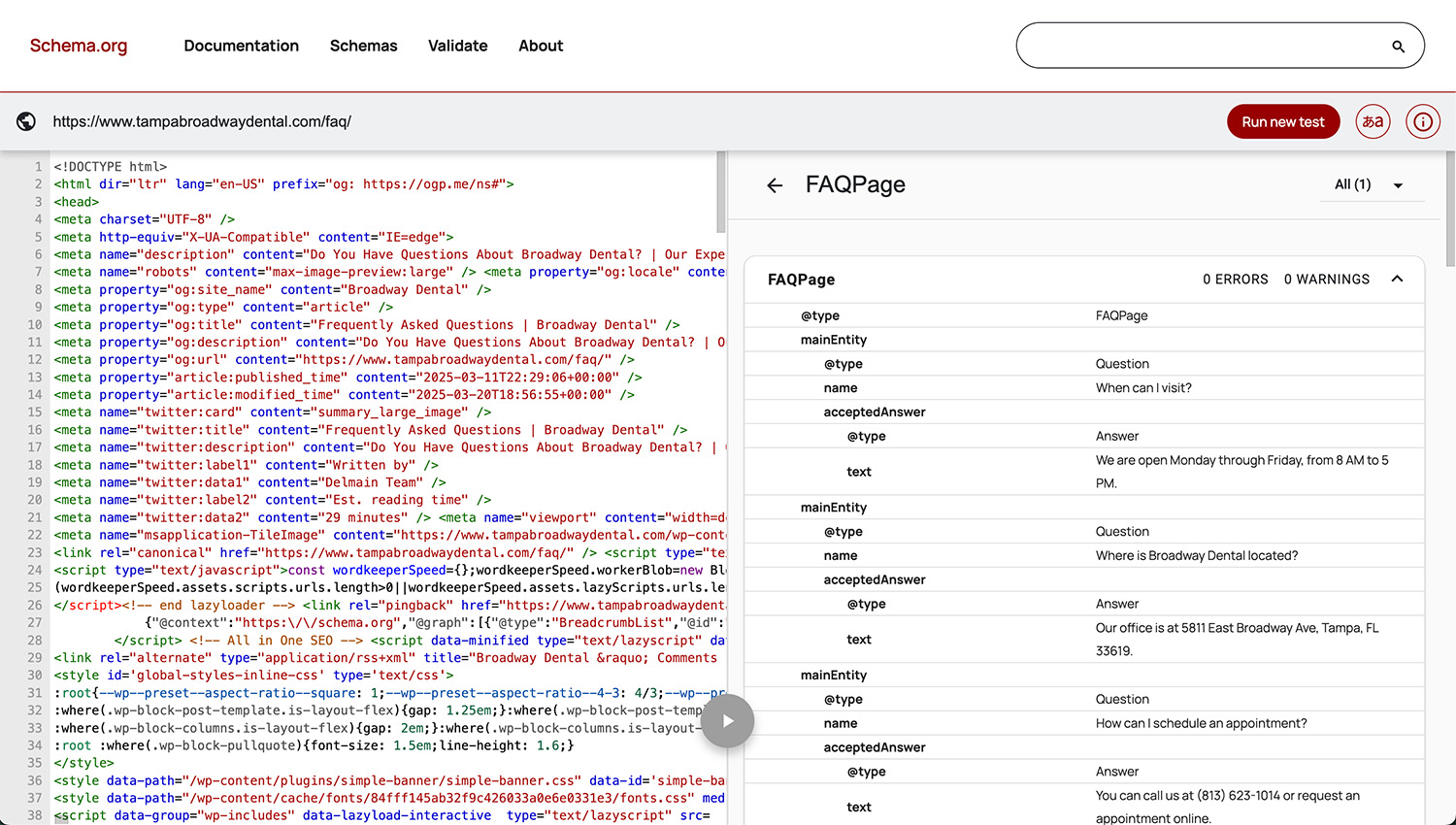
Schema markup is code on the back end of your site that tells search engines and AI tools exactly what’s on each page: your practice name, location, hours, services, and FAQs. Patients never see it. AI tools read it constantly. For dental practices, the priorities are LocalBusiness (or Dentist) schema sitewide and FAQ schema on pages that answer questions.
Why it matters: Schema removes the guesswork about who you are and what you offer, which raises your chances of being pulled into rich results and AI answers.
See it in action: The behind-the-scenes schema code on the left, and the FAQ dropdowns it produces in Google results on the right.
4. Say the same thing everywhere
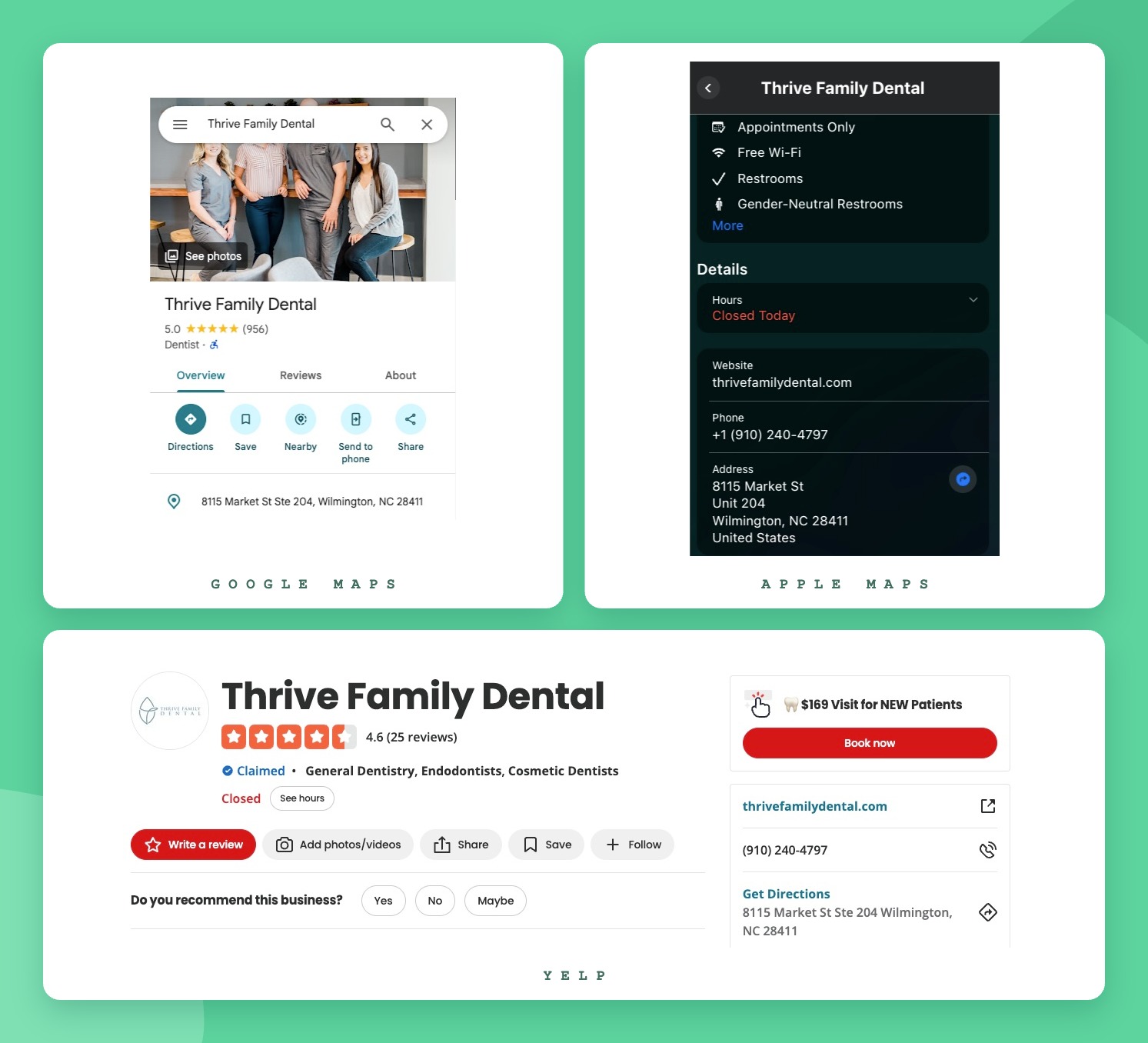
AI tools verify before they recommend. Audit your Google Business Profile, Bing Places, Apple Maps, Yelp, and Facebook. Your name, address, phone number, hours, and service list should match your website exactly.
Why it matters: If your website says you open at 7am, Google says 8am, and Yelp lists your old address, that inconsistency reads as unreliability, and the AI moves on to a practice it can verify. This is tedious work, and it’s some of the highest-return effort in all of AEO.
See it in action: A partner’s matching hours and contact details across Google, Yelp, and their website, side by side.
5. Keep reviews coming
Reviews carry even more weight with AI tools than they did in traditional search, because AI reads the text. Build a steady ask into your checkout process, and respond to every review. Response activity signals an actively managed practice.
Why it matters: A review that says “Dr. Chen made my daughter’s first filling completely painless” teaches the AI that your practice handles pediatric patients well, in a patient’s own words.
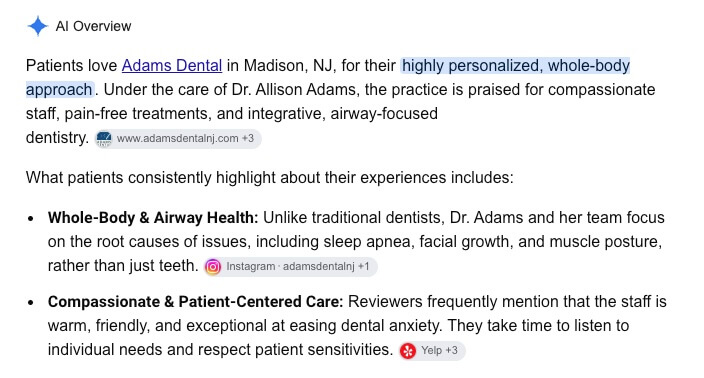
See it in action: An AI answer recommending a practice and echoing language pulled straight from its reviews.
6. Show your credentials
AI tools are cautious with health topics and prefer sources that demonstrate real expertise, the E-E-A-T factors Google has emphasized for years. Name your dentists on every relevant page, with degrees, specialty training, and association memberships. Add author bylines to clinical content.
Why it matters: A cost breakdown reviewed by a named DDS beats an anonymous page every time.
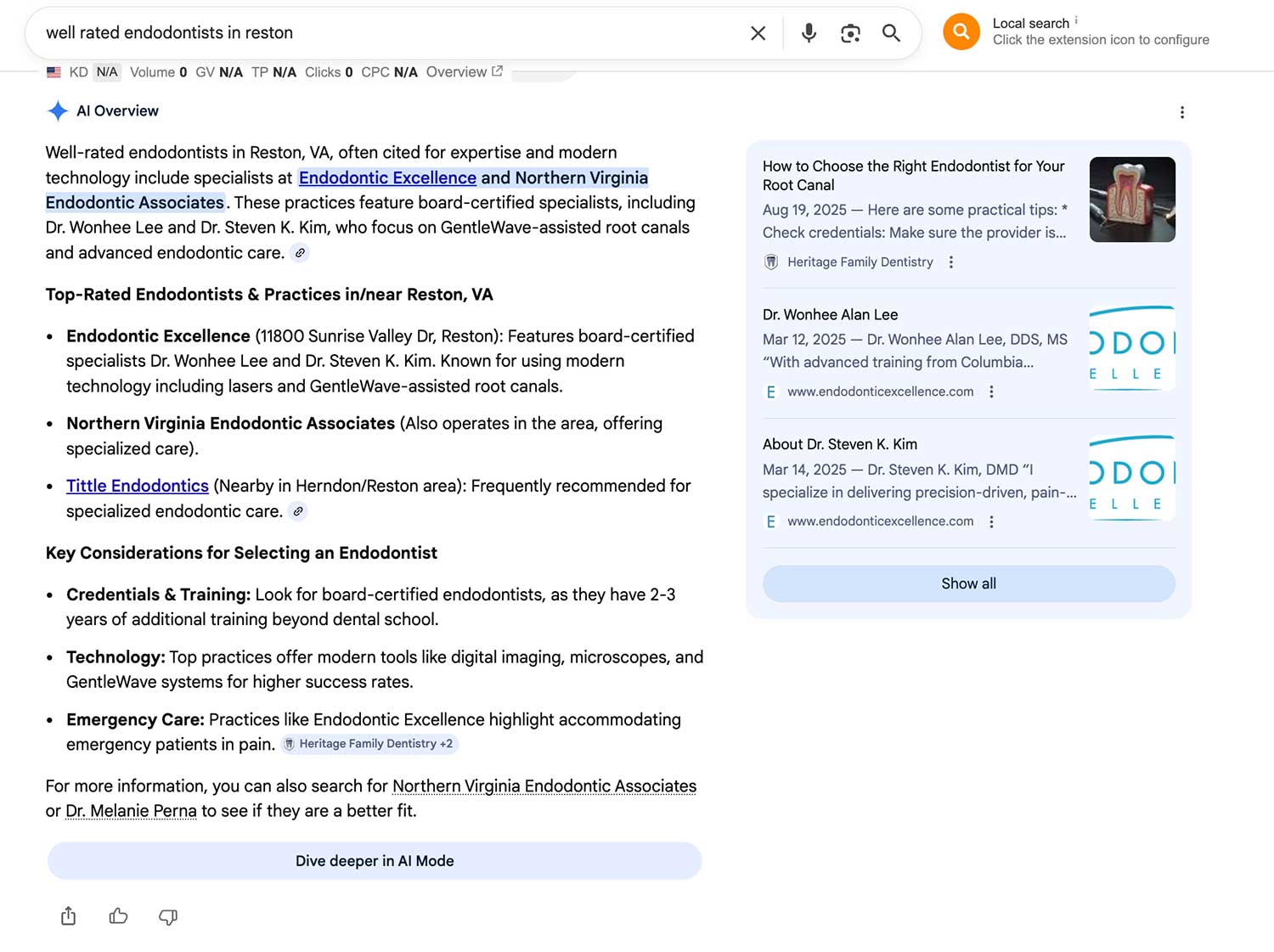
See it in action: Google’s AI Overview featuring a practice by name, calling out its doctors and their board certifications.
Want to dive deeper into AI?
Explore what an AI-ready site looks like page by page.
What Does It Really Mean for Your Dental Website to Be AI Optimized?
Measuring the success of your AEO efforts
Talking about AI visibility is one thing. Proving it works is another. That’s why we’ve built tracking into every retainer program for our partners.
The first thing we look at is patient-style questions
Instead of typing “dentist near me,” people now ask full questions like “How much do dental implants cost?” Using Google Search Console, we can see how often your site shows up for these real-world queries, the same ones patients ask before they ever pick up the phone.
The second thing we track is citations inside AI results
Picture this: a patient asks Google about implants, and the AI response begins with “According to [Your Practice Name].” That’s visibility and authority you can’t buy with ads. We measure how often your site is pulled into AI-powered answers across Google, Gemini, and Perplexity, plus your share of voice: how often your practice is named compared to nearby competitors. One pediatric partner’s share of voice now sits 73% ahead of its closest competitor. We review these results with you directly.
And the clicks follow. For that multi-location practice in Indiana, ChatGPT became the eighth-largest source of website visits this year. Those visitors clicked “Book Online” 128 times and engaged with the site at a higher rate than visitors arriving from Google’s organic results.
See it in action: snapshots from recent partner reports
When we first wrote about AI-friendly SEO in 2025, one of our partners, a periodontist in Atlanta, had been cited 208 times across 19 pages in Google’s AI Overview results. Less than a year later, four-figure counts are common: recent audits found 1,715 AI citations for a general dentist in Michigan and 1,656 for a practice in Overland Park, Kansas.
Common questions about AEO for dental practices
Is answer engine optimization different from SEO?
AEO is an extension of SEO, and most of the work overlaps. SEO earns you a position on the results page. AEO earns you a spot inside the answer at the top of it. A practice with strong SEO fundamentals usually needs structural changes (question-based headings, direct answers, schema markup) rather than a whole new strategy.
How long does it take to get cited by AI search?
Expect early citations within two to four months of publishing well-structured answers, with meaningful visibility building over six to twelve months. AI tools refresh their sources faster than traditional rankings move, so a genuinely better answer can get picked up quickly.
Which AI platform should a dental practice focus on?
Start with Google’s AI Overviews, since they sit on top of the search results your patients already use. The same work carries over: clear answers, consistent listings, and strong reviews are what ChatGPT, Perplexity, and Gemini reward too.
What is the difference between SEO, GEO, and AEO?
SEO is the work of earning a position in traditional search results. AEO and GEO both describe optimizing to be named inside AI generated answers: AEO focuses on answer engines like Google’s AI Overviews, while GEO (generative engine optimization) refers to generative tools like ChatGPT and Gemini. The two overlap almost completely, and both build on the same SEO fundamentals: clear answers, accurate listings, strong reviews, and a site search engines can read.
Can you pay to appear in AI search answers?
No. There is currently no way to buy a spot inside an AI answer the way you can buy an ad in traditional search results. AI tools choose sources based on accurate business information, helpful content, and strong reviews, so the practices that get cited earned it. That also means a smaller practice can beat a heavily advertised competitor by publishing better answers.
What is AI share of voice?
AI share of voice is the percentage of AI generated answers in your market that name your practice, measured against the practices named instead of you. It’s separate from overall citation count. Citations tell you how often you were quoted. Share of voice tells you how often you won the answer when a competitor could have.
Get found where patients are asking
If this feels like a lot, start with the two steps that move fastest: make your business information identical everywhere it appears, and rewrite your most-visited service page around the real questions patients ask. The practices doing this work now are the ones patients will hear recommended, in Google’s answers and in ChatGPT’s.
Already a :Delmain partner? Talk with your account manager about where we see the biggest AEO opportunities for your practice.
Not a partner yet? Book a free intro call, and we’ll show you how visible your practice is in AI search right now.
About the Author
With nearly a decade of experience, Hannah is a Senior SEO Strategist who specializes in scaling organic growth through data-driven strategies and collaborative problem-solving. Her expertise lies in Local and Organic SEO, with additional experience in Google Ads, Meta Advertising, and Social Media Marketing. Passionate about aligning cross-channel strategy with long-term results, Hannah is also an active contributor in Google’s Product Expert community for Business Profile and Maps, offering insights and troubleshooting visibility challenges.
Keep Reading

Best & Most Popular Dental Podcasts
Do you want to stay up-to-date on the latest dental industry trends, emerging technologies, methods for efficiently running your practice, and strategies to attract new patients? Dental podcasts offer a convenient way for dentists to stay informed and competitive.

20 Best Orthodontic Websites of 2026 & What They Got Right
Your orthodontic website can and should be your #1 source of new patients. How? By designing an orthodontic site that ranks highly in search engines, communicates what makes your practice unique, and impresses visitors. The best orthodontic websites are also designed to be mobile-first and very easy to navigate.

15 Best Pediatric Dental Websites of 2026 & What They Got Right
Parents have big expectations when entrusting their children with a pediatric dentist. The best way to make a good first impression and win them over? WOW’ing them with a well-designed pediatric website.

The Top 35 Books for Dentists of 2026
In the dynamic world of dentistry, staying informed is crucial. Wondering what books your peers are reading? We’ve got you covered with our list of the 31 best dental books for 2024, all highly recommended by dentists and dental experts.

The Truth About ADA Compliant Websites for Dental Practices in 2022
Here’s the truth — nothing you do to make your dental practice’s website ADA compliant can stop someone from suing you. If someone wants to file an opportunistic lawsuit, they can.

HIPAA Compliance For Dental Websites: Making Sense Of It All
How many emails do you get every week from an expert in HIPAA compliance wanting to sell you their services or a new piece of software? Many sales pitches focus on the fear of what might happen or what could happen if you don’t buy the latest HIPAA compliant solution.

Patients
Book your free intro call
Stop wasting marketing dollars! We’re ready to maximize success across your dental marketing efforts. Get your free consultation on targeting the right patients at the right cost. :Delmain’s plug-and-play marketing system is built for dentists, allowing you to predict, plan, and expand effortlessly.