Dental Advertising ROI: Real Benchmarks (and How to Measure Yours)
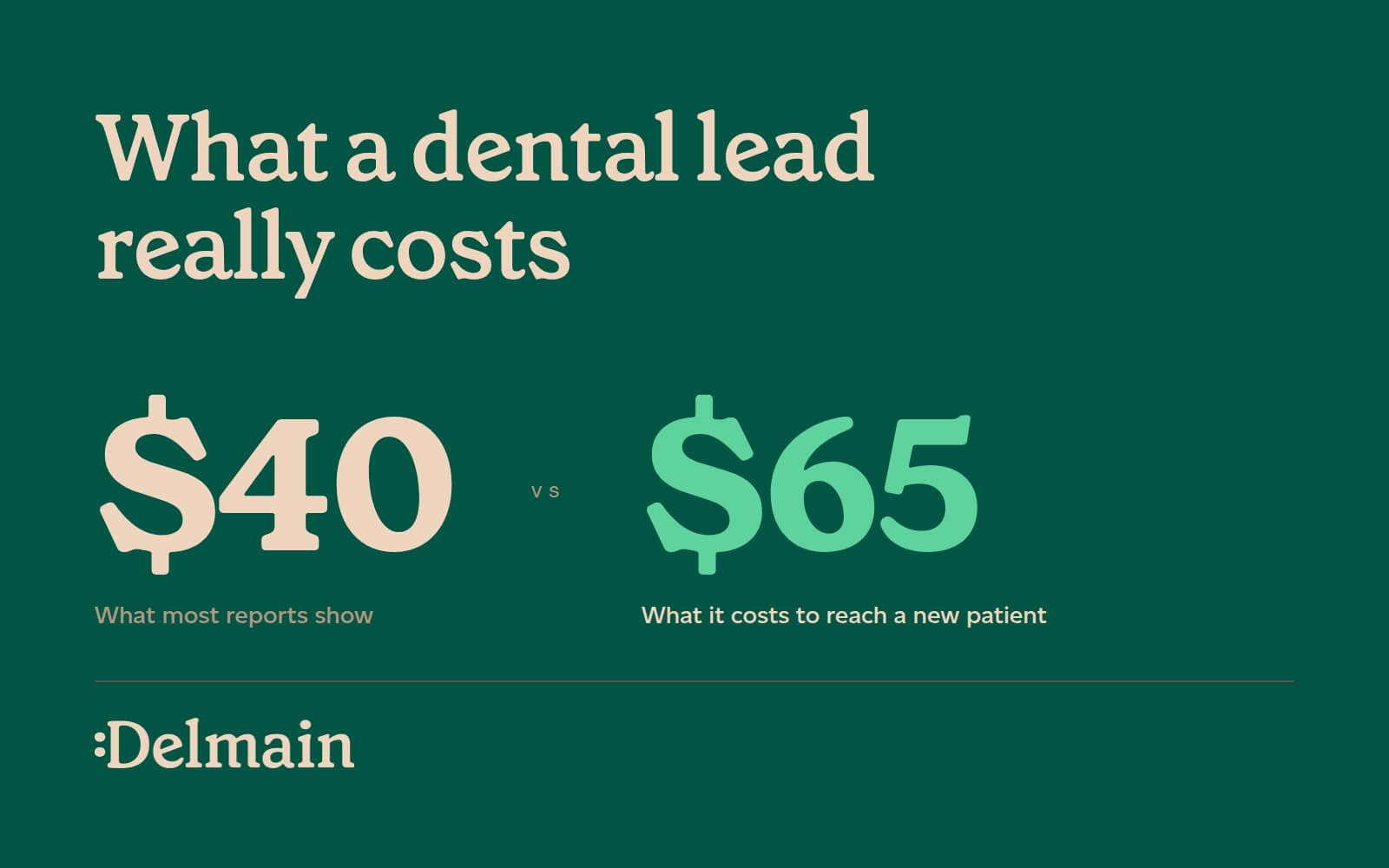
Explore real benchmarks for dental marketing ROI. Across 142 dental practices, paid search cost $40 per lead. Excluding branded traffic, reaching a new patient costs $65.
- 13 min read
- Aug 2026
-
 Kristin Meyer
In this article
It takes more than one yardstick to measure dental advertising ROI. Most practices lump their measurements together, which hides what their ads are actually delivering. Here’s the approach :Delmain uses, built on what 142 dental practices spent over the last 90 days.
Short answer: across 142 :Delmain dental practices, paid search cost $40 per lead over the last 90 days. That number is misleading. Strip out the people who already searched your practice by name and the real cost to reach a new patient is $65. Most practices are measuring the first number and budgeting against the second.
Key points in this article
- Blended cost per lead hides the real number. Paid search across 142 practices came in at $40 per lead. Excluding branded campaigns, the cost to reach someone new is $65.
- Performance Max and Local Services Ads belong on their own lines. Performance Max reported leads at $11 against $40 for regular search, a gap driven by what each campaign type counts rather than by real efficiency.
- Cost per lead is only step 1 of 4. Booking and show rates are what turn a lead number into a cost per seated patient, and almost no practice gets that far in its measurement.
What a dental lead actually costs right now
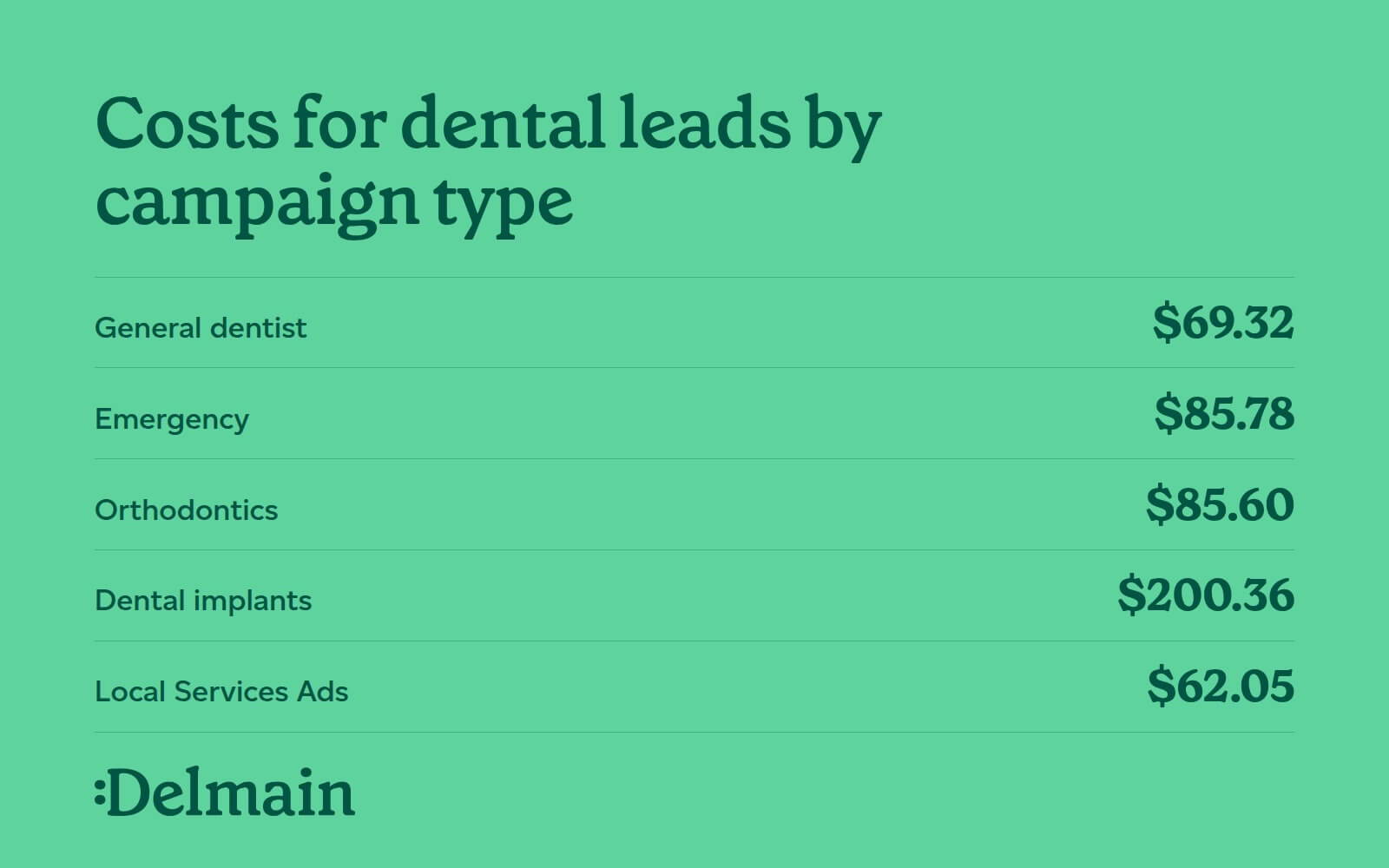
The following are account-level medians from :Delmain partner campaigns, May 27 to August 24, 2026. Median means the middle practice, not the average, so one unusually expensive account can’t drag the number. The range is the middle 50% of practices, so half of all practices land inside it.
| Campaign | Practices | Median cost per lead | Middle 50% of practices |
|---|---|---|---|
| General dentist | 96 | $69.32 | $47.93 to $101.83 |
| Emergency | 34 | $85.78 | $65.91 to $137.33 |
| Orthodontics | 11 | $85.60 | $51.92 to $219.61 |
| Dental implants | 14 | $200.36 | $111.26 to $231.51 |
| Local Services Ads | 36 | $62.05 | $46.55 to $87.16 |
The spread matters more than the median. Two general dentists running the same budget in different markets can sit at $48 and $102 per lead and both be performing normally. If someone quotes you a single national number for “dental cost per lead,” they’re averaging away the only thing that tells you whether your account is healthy.
Why your blended cost per lead is probably wrong
Blended cost per lead means every campaign averaged into one number, branded and non-branded together. It’s the number most reports lead with, and it’s the one that hides the problem. Here is the split across those 142 practices:
- Branded campaigns (people typing your practice name): $8.20 per lead. They deliver 44% of all leads on 9% of the spend.
- Everything else (people searching “dentist near me,” “emergency tooth pain,” “dental implants”): $65.06 per lead, on the other 91% of the spend.
Branded traffic is cheap because those patients already decided to find you. Your SEO, your reviews, and your existing patients earned them. Counting them in your ad performance makes your ads look about 38% cheaper than they are at bringing you someone new.
Action: Ask for your cost per lead with branded campaigns excluded. If your team can’t produce that number in one report, that is the first thing to fix.
Get Free Insights on How to Improve Your Advertising ROI
We’ve helped hundreds of practices improve their ad performance. Talk with our team for free insights on yours.
What Performance Max is doing to your numbers
Performance Max is Google’s automated campaign type. It reports leads very cheaply. Across 55 :Delmain dental accounts, Performance Max reported leads at $11 each while regular search reported $40 each.
The clearest example is Invisalign. Fifteen practices running Invisalign on search paid $192 per lead. Eight running it through Performance Max paid $8.66. The treatment didn’t get 22 times easier to sell in 90 days. The campaign type is counting different things, including low-intent actions that never reach your front desk.
Action: Report Performance Max separately from search. Never blend them into one account cost per lead, and check Performance Max leads against booked appointments before you move budget into it.
Where Local Services Ads land
Local Services Ads (LSAs) are the “Google Guaranteed” listings above the regular ads. You pay per lead, not per click. Across 46 :Delmain practices, the cost is $57.44 per lead.
This might sound like a good or bad cost per lead, depending on what comparisons you run.
Against blended search at $40, LSAs look 44% more expensive. Against non-branded search at $65, the number that actually reflects reaching a new patient, they come in 12% cheaper. Same ads, opposite conclusions, which is the whole reason the blended number is worth throwing out. One tradeoff is that an LSA lead comes in as a phone call or a message, not a click. Practices with strong review counts get the better end of this.
:Delmain’s Point of View: wait until your practice has at least 25 Google reviews before launching LSAs. Google ranks these listings partly on review count and rating. With under 25 reviews, you sit below practices with 200 of them, so lead volume will stay low no matter what you budget. Build the review count first, and launch second.
2026 examples: three dental practices that cut cost per lead without spending more
Here are real numbers from accounts with flat budgets over 90 days (but improved cost per lead nonetheless).
- A general, implant, and orthodontic practice: Spend went from $2,122 to $2,110. Leads went from 24 to 76. Cost per lead dropped from $88.40 to $27.77.
- A family and cosmetic practice: Spend went from $2,314 to $2,236. Leads went from 47 to 102. Cost per lead dropped from $49.22 to $21.93.
- A large multi-service practice: Spend went from $23,795 to $21,019. Leads went from 100 to 137. Cost per lead dropped from $237.34 to $153.82.
None of these came from a budget increase. All three came from cutting search terms that were spending without converting, tightening the geographic radius, and sending clicks to a page built for that specific service instead of to the homepage.
Win More Patients Through Targeted Ads
Talk with our team about how to fill your chairs with your ideal patients.
How to measure your own ROI: the 4-step check
Run this on your last 90 days. It takes about 20 minutes with your ad account and your practice management software open.
- Pull cost per lead with branded excluded. This is your real new patient lead cost. Compare it to the table above for your campaign type.
- Separate Performance Max and Local Services Ads into their own lines. You should be looking at three numbers, not one.
- Count how many of those leads booked appointments. Divide bookings by leads. Under 30% is a front desk problem, not an ads problem.
- Count how many booked patients showed up. Cost per lead divided by your booking rate and your show rate gives your true cost per seated patient.
Most practices stop at step 1 and use the wrong version of it. Getting to step 4 puts you ahead of nearly every practice in your market.
To take it farther: pull the production value of those booked patients from your practice management software, then divide production by ad spend. That’s the concrete return your ads produced. Every number above this line is a proxy for it.
Method
We analyzed 90 days of :Delmain partner accounts, May 27 to August 24, 2026, pulled from the Google Ads data warehouse on August 25, 2026. Dental accounts are those running at least one general dentist, emergency, implant, orthodontic, or pediatric campaign. We analyzed 142 for search figures, 55 for Performance Max, and 46 for Local Services Ads. Search figures exclude Performance Max campaigns throughout. Leads are conversions as counted in Google Ads (calls, form fills, and booking clicks). Account-level medians are limited to accounts with over $1,000 in spend and at least 5 leads in that campaign type during the window.
Common questions about dental advertising ROI
What is a good cost per lead for dental advertising?
It depends entirely on the campaign type and your market. Across 142 :Delmain dental practices, the median was $69.32 for general dentistry, $85.78 for emergency, $85.60 for orthodontics, and $200.36 for implants. Just as important is the spread: two general dentists can sit at $48 and $102 per lead and both be performing normally. Compare yourself to your own campaign type, not to a single national average.
How do you calculate dental advertising ROI?
Start with cost per lead with branded campaigns excluded, then divide bookings by leads to get your booking rate, then divide show-ups by bookings to get your show rate. Cost per lead divided by those two rates gives your true cost per seated patient. For the full picture, pull the production value of those booked patients from your practice management software and divide production by ad spend. Everything short of that last step is a proxy.
Why is my branded cost per lead so much lower than everything else?
Because those patients already decided to find you. Branded campaigns (people typing your practice name into Google) came in at $8.20 per lead and delivered 44% of all leads on just 9% of the spend. Your SEO, your reviews, and your existing patients earned that traffic, not your ads. Leaving branded in your reporting makes your advertising look about 38% cheaper than it really is at bringing in someone new.
Should I trust the lead numbers Performance Max reports?
Not without checking them against booked appointments first. Across 55 :Delmain dental accounts, Performance Max reported leads at $11 each while regular search reported $40. The Invisalign gap was starker still: $192 per lead on search versus $8.66 through Performance Max. The campaign type is counting different actions, including low-intent ones that never reach your front desk. Report it on its own line and verify before you shift budget into it.
Are Local Services Ads worth it for a dental practice?
Across 46 :Delmain practices, LSAs ran $57.44 per lead. That is 44% more expensive than blended search at $40, but 12% cheaper than non-branded search at $65, which is the fairer comparison since both are reaching new patients. The catch is review count: Google ranks these listings partly on reviews, so if you have fewer than 25, you will sit below practices with 200 and volume will stay low no matter your budget. Build reviews first, then launch.
About the Author
Kristin Meyer leads PPC strategy and performance at :Delmain. She oversees paid media across Google Ads, Performance Max, Local Services Ads, and Meta, managing multi-million-dollar portfolios and performance across 70+ concurrent accounts.
Her work centers on making ad spend accountable for dental practices: measuring what actually reaches a new patient, separating the campaign types that report differently, and tying lead numbers back to booked and seated appointments.
Keep Reading

Best & Most Popular Dental Podcasts
Do you want to stay up-to-date on the latest dental industry trends, emerging technologies, methods for efficiently running your practice, and strategies to attract new patients? Dental podcasts offer a convenient way for dentists to stay informed and competitive.

20 Best Orthodontic Websites of 2026 & What They Got Right
Your orthodontic website can and should be your #1 source of new patients. How? By designing an orthodontic site that ranks highly in search engines, communicates what makes your practice unique, and impresses visitors. The best orthodontic websites are also designed to be mobile-first and very easy to navigate.

15 Best Pediatric Dental Websites of 2026 & What They Got Right
Parents have big expectations when entrusting their children with a pediatric dentist. The best way to make a good first impression and win them over? WOW’ing them with a well-designed pediatric website.

The Top 35 Books for Dentists of 2026
In the dynamic world of dentistry, staying informed is crucial. Wondering what books your peers are reading? We’ve got you covered with our list of the 31 best dental books for 2024, all highly recommended by dentists and dental experts.

The Truth About ADA Compliant Websites for Dental Practices in 2022
Here’s the truth — nothing you do to make your dental practice’s website ADA compliant can stop someone from suing you. If someone wants to file an opportunistic lawsuit, they can.

HIPAA Compliance For Dental Websites: Making Sense Of It All
How many emails do you get every week from an expert in HIPAA compliance wanting to sell you their services or a new piece of software? Many sales pitches focus on the fear of what might happen or what could happen if you don’t buy the latest HIPAA compliant solution.

Patients
Book your free intro call
Stop wasting marketing dollars! We’re ready to maximize success across your dental marketing efforts. Get your free consultation on targeting the right patients at the right cost. :Delmain’s plug-and-play marketing system is built for dentists, allowing you to predict, plan, and expand effortlessly.