What Does It Really Mean for Your Website to Be AI Optimized?
AI search is rewriting the rules of SEO. Patients are asking Google and ChatGPT questions like “How much does Invisalign cost near me?” — and they’re getting instant answers. If your site isn’t optimized for AI, those patients are going straight to another dentist.
- 8 min read
- Sep 2025
-
 Hannah Moen
Key Points
AI search tools like Google’s AI Overviews, Perplexity, and ChatGPT are changing how patients find dentists.
- Traditional SEO isn’t enough — your site must be structured for AI-friendly SEO.
- Key tactics include: clear/scannable content, schema markup, entity optimization, conversational phrasing, and trust signals (E-E-A-T).
- Blogs are more important than ever for answering patient-style questions and boosting local authority.
Google is changing the way patients search for a dentist with AI Overviews — instant, AI-generated summaries that show up right at the top of search results. Instead of scrolling through a list of websites, patients are handed quick answers, often pulled directly from dental practices.
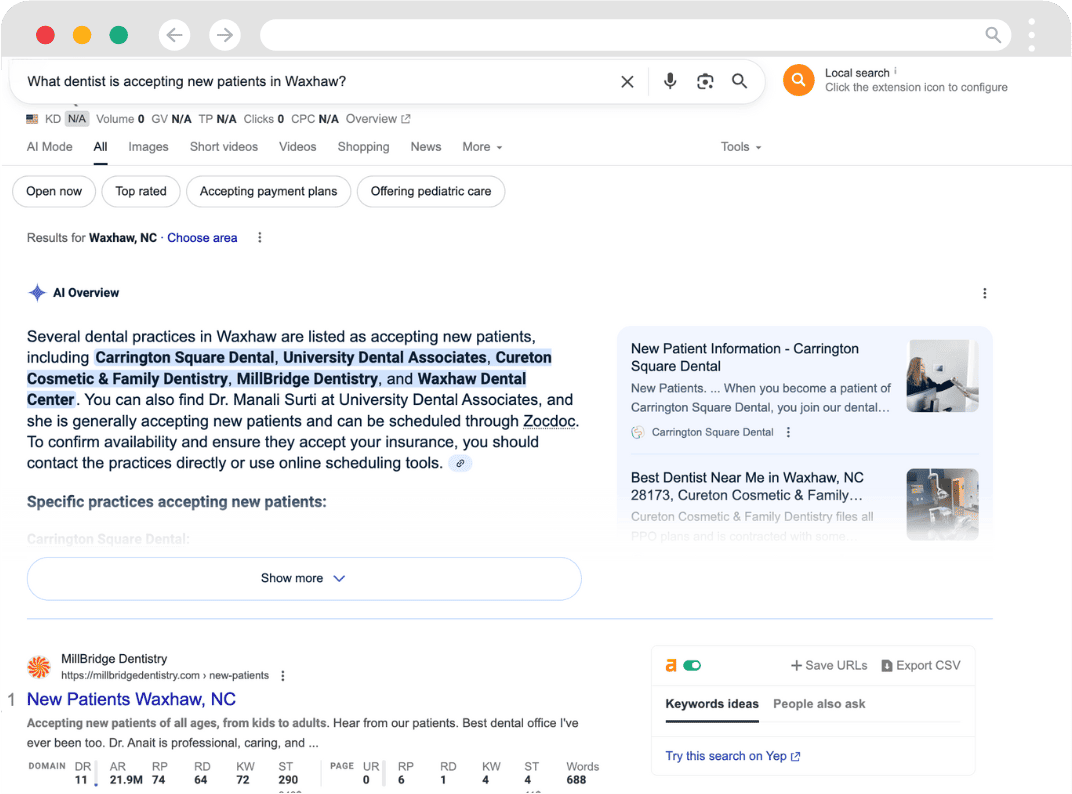
Other tools, like Perplexity and ChatGPT, work the same way: patients ask a question, and the AI serves up a conversational, one-stop response. That means the search journey starts, and often ends, before a patient ever clicks into your website.
The questions showing up in these AI results sound familiar:
- “How much does Invisalign cost in Portland?”
- “Where can I find the best family dentist near me?”
If your dental website isn’t built to answer these AI-style queries, you’re invisible at the exact moment patients are making decisions. And if you’re not showing up, you’re handing those patients straight to your competitors. That’s why SEO strategies for dentists are evolving.
What “AI-friendly SEO” looks like in action
Keeping your practice visible in today’s AI-driven search results takes a different approach than traditional SEO. At :Delmain, we call it AI-friendly SEO, a strategy built to make sure Google and other AI systems see your website as credible, authoritative, and worth citing.
1. Content clarity & structure
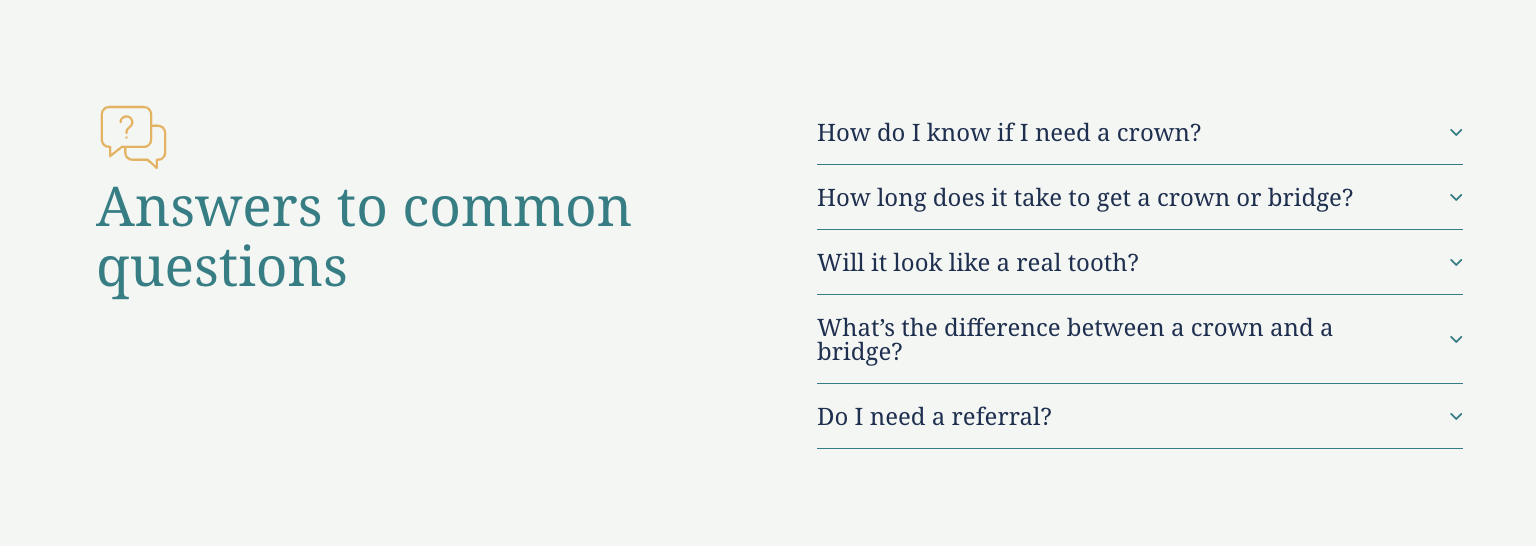
AI search tools scan pages looking for snippets of information they can extract quickly. That means long, dense paragraphs are less effective than short sections with clear headings, FAQs, and bullet points.
Why it matters: When your content is scannable, AI tools can easily pull the exact answer a patient is looking for and surface it in an overview. That gets your practice cited more often and puts you in front of patients earlier in their decision process.
???? See it in action: Here’s a service page FAQ block. Each question expands to show a short, direct answer. This format makes it easy for patients to scan and easy for AI to pull answers directly into overviews.
2. Schema markup
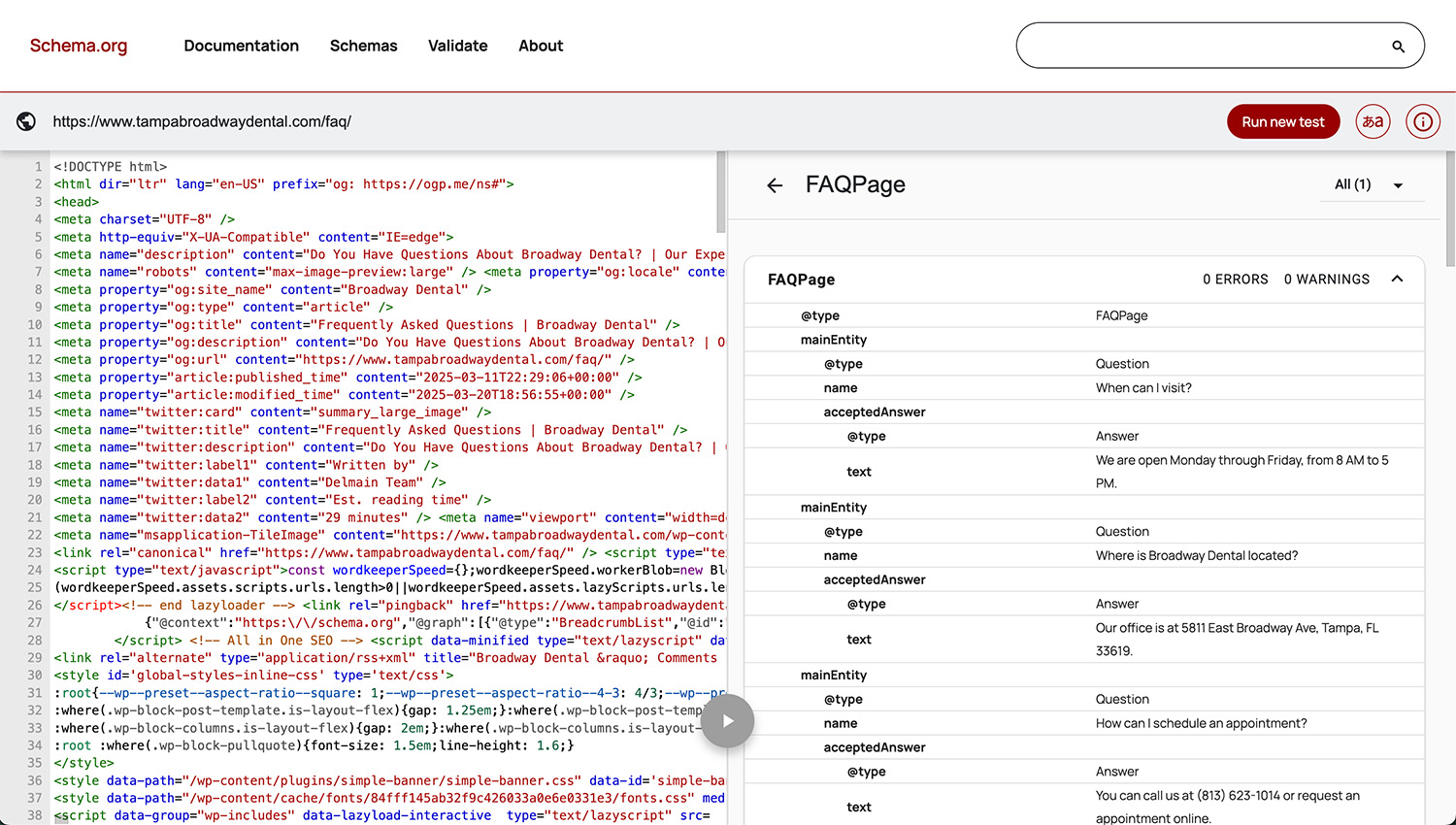
Schema is structured data — invisible code on the back end that tells Google and AI tools exactly what’s on a page. For example, FAQ schema tells Google, “This section is a question and answer,” while LocalBusiness schema confirms your hours, address, and phone number.
Why it matters: Schema helps your site stand out with rich results (think star ratings and FAQs showing directly in search). It also increases your chances of being pulled into AI answers because the search engine doesn’t have to guess what your content means.
See it in action: On the left is the behind-the-scenes schema code we add to a page. On the right, you can see how it produces FAQ dropdowns in Google search results. Schema connects the dots for AI and increases your chances of being featured.
3. Entity optimization
What is entity optimization for a dental website?
Entity optimization is the work of making search engines and AI tools understand your practice as a specific, verified thing: a named business, its providers, its services, and its location. You build it by linking provider bios to service pages, service pages to location pages, and keeping your name, address, and phone consistent everywhere.
When a patient searches, AI wants to know exactly who provides the service, where they’re located, and why they should be trusted. For your practice, that might mean AI needs to see that you offer Invisalign in Portland, that Dr. Smith is the provider, and that patient reviews point back to your brand. Strengthen these connections by linking provider bios to service pages, service pages to location pages, and consistently incorporating your brand terms.
Why it matters: The stronger these connections, the more likely your practice is to be recognized as a “known entity”. And that means you’ll be more likely to be cited as an authority when patients search locally.
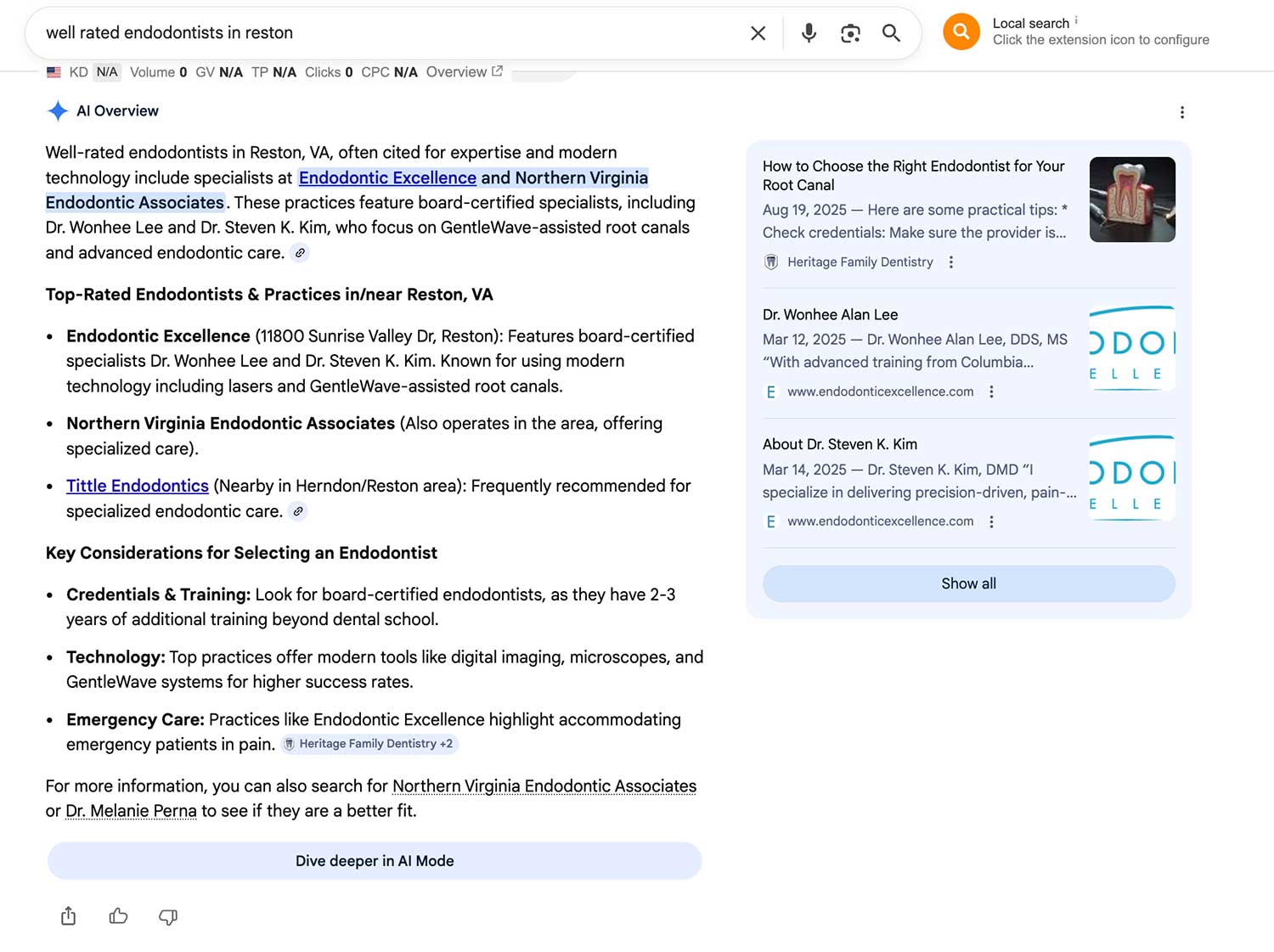
See it in action: Take a look at how Google’s AI Overview features our partner Endodontic Excellence by calling out Dr.Lee and Dr.Kim by name, highlighting their board certifications, and spotlighting their use of GentleWave technology. These signals highlight how AI is actively rewarding E-E-A-T factors (professional credentials, positive reviews, and proven results) when choosing which providers to feature.
4. Conversational phrasing
AI search reflects how people talk. Patients aren’t typing “Invisalign cost”, they’re asking, “How much does Invisalign cost in Portland?” Shape headings, FAQs, and blog topics to mirror these natural questions, so your content is the most relevant match.
Why it matters: When your copy mirrors patient phrasing, AI tools view it as a direct answer, which boosts your chance of being cited or featured.
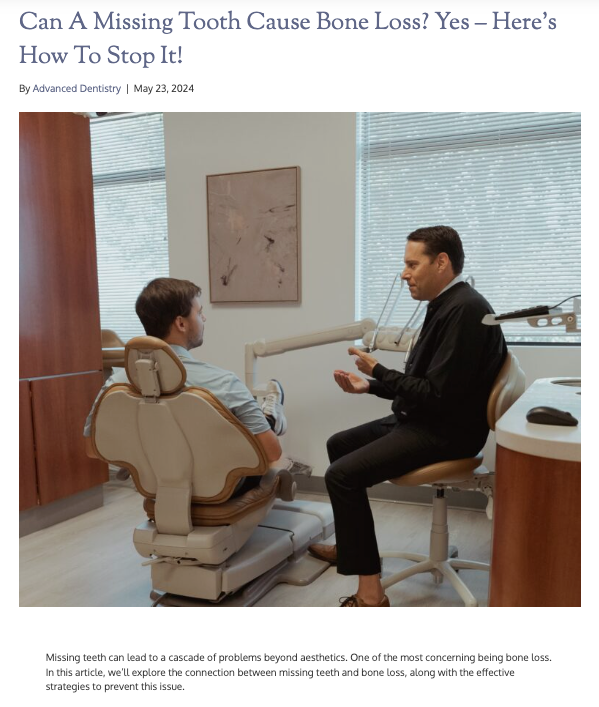
See it in action: This blog headline mirrors how a patient would actually ask the question: “Can a missing tooth cause bone loss? Yes!” Both the title and the first paragraph give a concise answer, making it the kind of content AI loves to cite.
5. Source trustworthiness
Search engines want to recommend sources they can trust. That means your site needs clear E-E-A-T signals. Be sure to add robust provider bios (with credentials and memberships), cite reputable sources, and showcase reviews directly on pages.
Why it matters: These trust signals make it easier for AI systems to recognize your site as reliable, which means patients are more likely to see your practice quoted or recommended in AI answers.
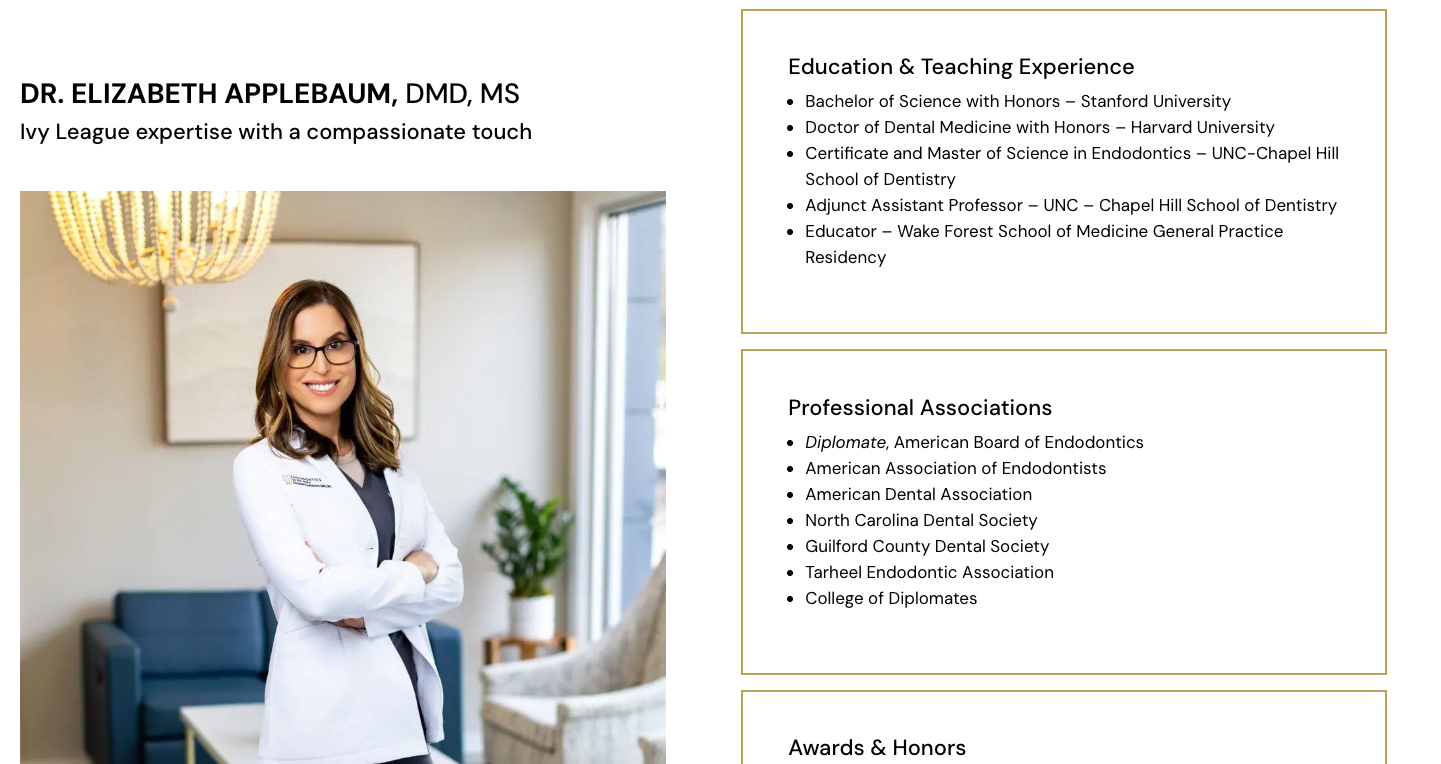
See it in action: This About page highlights the doctor’s credentials, associations, awards, and publications, paired with an in-depth bio. These details send strong credibility signals, showing both AI and patients that your practice is a trustworthy source.
Bonus! Blogs are back in a big way
Service pages are still the foundation of dental SEO. They’re what bring in local patients who are ready to book an appointment today, and they’re a core focus of our content strategy here at :Delmain.
But with the rise of AI search, blogs have stepped back into the spotlight. Where service pages answer the transactional “I’m ready to book” queries, blogs now play a bigger role in capturing the conversational, research-style questions patients are asking earlier in their journey. That makes them a powerful complement to your site pages, helping your practice show up more often and in more places.
Here’s how blogs support AI-friendly SEO:
- Answering real patient questions → Blogs capture the long-tail, Q&A-style searches that AI Overviews love to feature.
- Strengthening local authority → By weaving in geography, provider names, and brand, blogs increase the likelihood your practice shows up in AI-driven results.
- Reinforcing brand presence → Knowing most transactional visits now come through branded searches, blogs help ensure your practice is top of mind.
- Creating AI-friendly signals → With FAQ and article schema, blogs provide the structured, scannable content AI systems are designed to pull from.
Our SEO services include blog production alongside core service pages and updates. Together, they create the right mix of local lead generation and AI visibility to keep your practice visible wherever patients are searching.
???? Want to dive deeper?
Explore how AI is reshaping dental marketing ROI.
Measuring the success of AI SEO efforts
Talking about AI-friendly SEO is one thing. Proving it works is another. That’s why we’ve built tracking into every retainer to show whether these updates are actually helping patients find you.
The first thing we look at is patient-style questions
Instead of typing “dentist near me,” people now ask full questions like “How much do dental implants cost?” or “What’s the best sedation option in Magnolia?”. Using Google Search Console, we can see exactly how often your site is showing up for these real-world queries — the same ones patients ask before they ever pick up the phone.
The second thing we track is citations inside AI results
Picture this: a patient asks Google about implants, and the AI response begins with “According to [Your Practice Name]”. That’s visibility and authority you can’t buy with ads. With Brand Radar, we measure how often your site is pulled into AI-powered answers across Google, Gemini, and even emerging tools like Perplexity.
We review these results with you directly, walking through how your practice is showing up in AI search results and where the biggest opportunities are.
See it in action – snapshot from a recent partner report
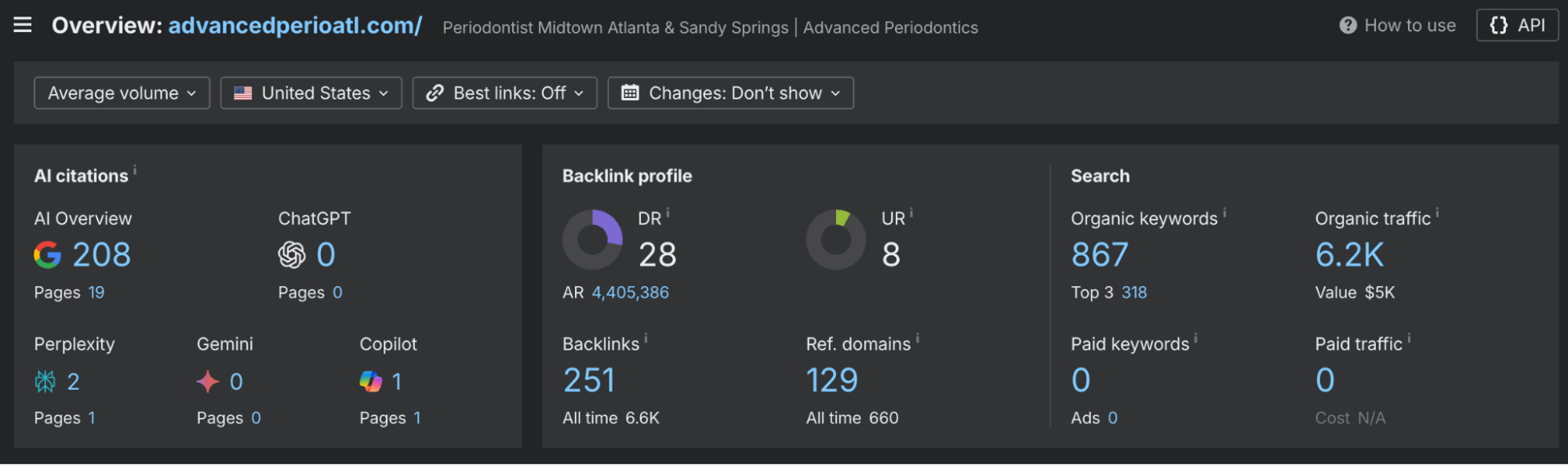
One of our partners, a periodontist in Atlanta, has already been cited 208 times across 19 pages in Google’s AI Overview results. This is a clear signal that their expertise is appearing right where patients are searching for answers.
Keep your practice in the AI spotlight
AI is changing how patients search and how practices show up. Our AI-friendly SEO approach ensures your investment is driving visibility today, and positioning you for growth tomorrow.
Already a :Delmain partner? Talk with your account manager about AI-friendly SEO and where we see the biggest opportunities for your practice. Or take a look at modern dental sites that are built to perform in both Google search and AI Overviews.
Common questions about AI-optimized dental websites
What does it mean for a dental website to be AI optimized?
An AI-optimized dental website is built so tools like Google’s AI Overviews, ChatGPT, Claude, and Perplexity see your site as credible, authoritative, and worth citing. At :Delmain we call this AI-friendly SEO. It relies on clear, scannable content, schema markup, entity optimization, conversational phrasing, and strong trust signals so AI can pull accurate answers about your practice.
How is AI-friendly SEO different from traditional SEO?
AI-friendly SEO is a subset of traditional SEO. Traditional SEO alone isn’t enough because patients so often get answers directly from AI tools before clicking any website. AI-friendly SEO structures your content for extraction, using short sections, clear headings, FAQs, and bullet points instead of long, dense paragraphs. This makes it easier for AI systems to surface your practice in their summaries.
What is schema markup and why does it matter for dental websites?
Schema is structured data. It’s invisible code on the back end that tells Google and AI tools exactly what’s on a page. FAQ schema flags a question and answer, while LocalBusiness schema confirms your hours, address, and phone number. Schema markup helps you stand out with rich results and increases your chances of being pulled into AI answers because the search engine doesn’t have to guess what your content means.
Why are blogs important for AI search visibility?
Blogs capture the conversational, research-style questions patients ask early in their journeys, the kind of long-tail queries AI Overviews love to feature. Blogs also strengthen local authority by weaving in geography, provider names, and your brand, and they create AI-friendly signals through FAQ and article schema. Service pages still drive ready-to-book patients, but blogs help you show up in more places.
How do I know if my AI SEO efforts are working?
Track how often your site shows up for patient-style questions using Google Search Console, and monitor how frequently you are cited inside AI results using a tool like Brand Radar across Google, Gemini, and Perplexity. Being cited in an AI answer is visibility and authority you cannot buy with ads. Reviewing these metrics over time shows whether your content is reaching patients where they search.
Keep Reading

Best & Most Popular Dental Podcasts
Do you want to stay up-to-date on the latest dental industry trends, emerging technologies, methods for efficiently running your practice, and strategies to attract new patients? Dental podcasts offer a convenient way for dentists to stay informed and competitive.

20 Best Dental Websites of 2026
We’re showcasing the very best dental websites of 2026. See examples of great dental websites from around the country, learn about the best features of each, and discover opportunities to improve your dental website design.

Top Dental Influencers to Follow
Owning a dental practice is a work in progress. Even well-established practices can be improved and fine-tuned as the industry, patient expectations, and competition evolve and adapt.

Patients
Book your free intro call