26 Dental Industry Stats to Know in 2026
- 9 min read
- May 2026
-
 :Delmain Team

Dental marketing needs to change as often as patient behavior changes. Changes in practice management, industry sentiment, and staff priorities also have a big effect on marketing. In 2026, we’ve seen several industry patterns stay the same.
But it’s also clear that:
- Patients are finding and choosing dental practices in new ways
- Dentists and their staffs face recurring burnout with administrative work (including marketing)
- Fewer practices are growing collections at the rates they want.
To guide hungry practices, we interviewed experts, analyzed 2026 performance for over 150 dental websites, and gathered fresh dental industry stats. Our findings highlight top opportunities for dentists to stand out, win more trust, and grow their practices this year.
Key points in this article:
-
- Dentists, their staff, and their patients share concerns about the state of the industry.
- The dental industry is growing, but only a handful of practices are seeing large gains.
- The practices driving growth are the ones that meet patients where they are, master operations, and build repeatable systems.
Dental industry stats on growth in 2026
1. The ADA reports that there are over 200,000 dentists in the U.S. today.
2. The dental services market is on track for 7% year-over-year growth in 2026, expanding from $440 billion to $471 billion.
3. In contrast with overall market growth, production per dentist is essentially flat according to the most recent Dental Economics-Levin Group Annual Practice Survey.
4. The figure above gets even harder to decipher given that 72% of practices reported higher production in 2025, according to the same study.
5. Only the top 8% of dental practices reported growth of more than 15% in the past year.
Implications | What is happening in the dental industry?
The clearest implications are:
- Despite financial turbulence in 2026, there’s an expanding need for dental services.
- It remains to be seen whether growth will outpace the rising costs of overhead. Dental technologies, office space, utilities, and talent are all more expensive this year. 27% of practices surveyed in the Dental Economics-Levin Group study said that overhead costs rose by 10% in the past year alone (nearly twice the average cost increases for the previous year).
- Leading practices are handily outpacing their peers. These select practices are winning a much larger share of the industry’s gains.
- It will be more important this year for dentists to fill empty hours and grow their patient base to be part of the wave of growth.
With the disparity between leading practices and others, the pressure is higher for middling practices to improve business operations and marketing, not just the quality of their clinical care.
“The growth in dentistry over the next few years will belong to operators who treat their practices like businesses, not hobbies, and who install the systems to back it up,” Scott Mortier, President of Scott Leune Education, told :Delmain. “Practice ownership is changing in ways the industry hasn’t fully caught up to. Today’s dentists want ownership without sacrificing their lives to it, which means they’re looking for systems, structure, support, and someone to help them implement it all, not the DIY model that their mentors used.”
Today’s dentists want ownership without sacrificing their lives to it, which means they’re looking for systems, structure, support, and someone to help them implement it all.
Take action
If you still have empty chairs or empty hours, set some growth goals today. Identify where you can build systems to elevate your practice, whether that’s in front desk operations, patient experience, marketing, or all of the above.
The following sections will give you tangible starting points. But it all hinges from an honest reflection on your practice growth
And if your practice is growing in line with your vision, pat your team and yourself on the back! And keep at the steps that brought you this far.
Influential trends in the dental industry in 2026
6. Teledentistry is on the rise. Online consultations are set to account for close to 30% of all consultations in 2026.
7. Dental insurance benefits grew last year, with Ameritas citing a wave of bigger yearly maximums ($2,500 to $5,000).
8. The industry continues to face an uphill fight for talent. At the end of 2025, the ADA Health Policy Institute reported that over half of all dental practices are dealing with staffing shortages, particularly a shortage of hygienists.
9. Last year saw a 15-percentage-point drop in dentists’ confidence about the general state of the industry.
10. Consumer confidence in their ability to afford dental services is also at risk. At the end of 2025, the Fed reported that 18% of adults in the U.S. were choosing not to receive dental care, mostly due to costs.
11. Despite the Fed’s findings, Q1 of 2026 saw a modest 4% increase in patient spending on dental services.
Implications | What trends are shaping the dental industry in 2026?
While the majority of practices face these same issues, finding the right solution usually takes a customized approach.
“As the dental industry evolves, successful practices are focusing on operational clarity, authentic patient relationships, leadership development, and personalized patient experiences that reflect the heart of their practice,” DiDi Lindvig-Lee, Director of Practice Solutions at Custom Dental Solutions, told :Delmain. “Custom Dental Solutions believes the future of independent dentistry is not built through one-size-fits-all systems, but through customized strategies that align with each doctor’s vision, philosophy, and team culture.”
Although worries about the state of the industry affect patients as well, there’s cause for optimism: New patients continue to value dental services and trust the leading practices with their care.
Take action
Next, evaluate your partners and tech stack. These will be the next best places to align your vision and practice operations.
Dental patient acquisition stats for 2026
Here are a few key stats on dental patient acquisition in 2026.
12. Approximately 71% of patients conduct online research on a dental practice before they choose to schedule an appointment.
13. The study cited just above also notes that 64% of patients find a dentist using its Google Business Profile (GBP).
14. In 2026, 40% of patients are using AI tools to research health-related services in their area.
15. ChatGPT is the clearly favored AI tool for discovering dental practices or other health-related services. 91.8% of AI searches for these services happen in ChatGPT.
16. Most significantly, 90% of people who conduct a local search related to health services take action within 24 hours.
17. The majority of patients look at a practice’s specific services before they book an appointment. Over 70% research dental treatments before they choose a practice to visit. Long-tail keywords (like “dental implants in NYC” or “emergency dental care in Chicago”) account for 92% of all these searches.
18. :Delmain’s own analysis of over 150 dental practice websites revealed that service-specific pages are the second-most likely pages to capture organic traffic. Only home pages on practice websites see more visits.
19. ClickVision also estimated that over 113,000 “dentist near me” searches occur every day.
20. The average cost to acquire a new patient booking is $150 – $250 in 2026.
21. :Delmain helped partners reach an average cost per lead of $102, based on our analysis of over 200 live campaigns this year.
22. The Dental Economics-Levin Group study found that 31% of dentists lack new patients, and that 50% are concerned with patients’ financial stability and confidence.
Implications | How are patients finding dental practices in 2026?
There’s a clear connection between dentists’ confidence in the industry and the overall sentiment of their patients. Dentists will need to help reassure and support patients in new ways as those patients face new concerns about their dental health.
“Patients are voting with their wallets for practices that deliver transparent pricing, flexible financing, and a frictionless experience from booking to checkout,” said Mortier.
“Today’s patients are seeking more than clinical care,” Lindvig-Lee shared. “They want trust, connection, convenience, and a team that understands their individual needs.”
The overall patient pool is still healthy. With 113K searches each day and a similar number of practices out there, there’s enough of a pie for each practice to win 20-30 new patients every month from organic searches (to say nothing of referrals, advertising, and other sources). The reality, however, is that the practices showing up in the top few search results win nearly all of these new patients.
AI has already become a key tool in how patients pick new practices. Your practice’s reputation (or lack of it) across AI citations will determine whether you get picked well before a patient picks up the phone or books online.
The good news, no matter where your dental practice is in its AI evolution, is that patients still rely greatly on GBP and practice websites in their dental journeys.
Today’s patients are seeking more than clinical care. They want trust, connection, convenience, and a team that understands their individual needs.
Take action
Ask your current marketing partners about your visibility across both search engines and AI platforms. Add fresh content to your Google Business Profile and practice website. Make sure your NAP (name, address, phone number) are consistent wherever they show up. Ask satisfied patients to share reviews of their experiences.
The practices that show up at the top are the ones doing the work to get there.
Case in point: a :Delmain partner success story
Stats on dental website engagement in 2026
Here are a few especially valuable findings from that analysis.
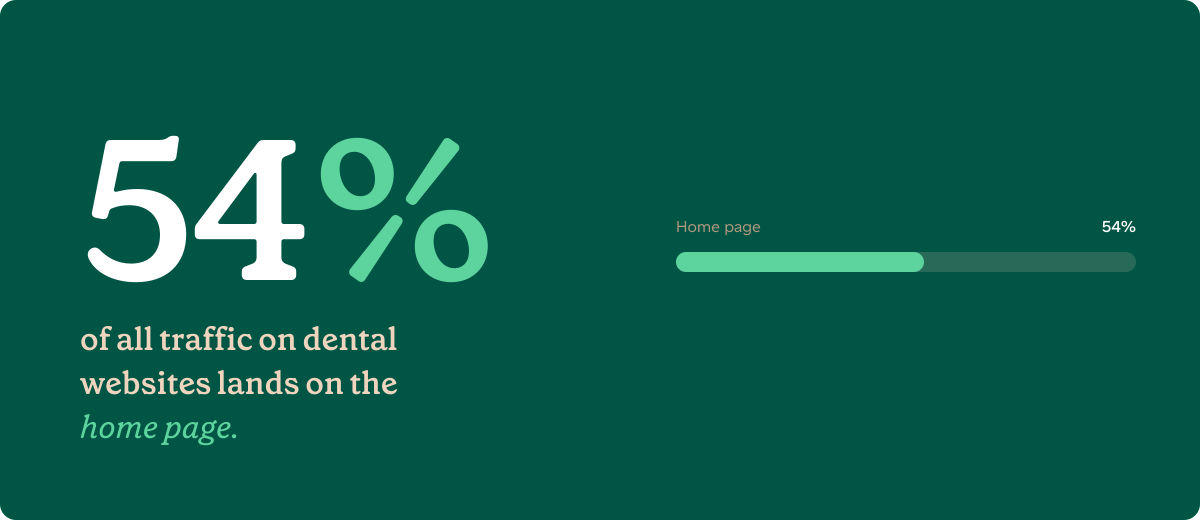
23. Home pages drive 54% of all traffic on dental websites. Some visitors complete their entire journey to a decision just by visiting a strong home page.
24. Dental practice home pages are also the top landing pages. This is the first impression and the first chance to win for 90% of all new patients.
25. Websites using unique photos and video (photos and video of their team and their offices) see patients engaging 30% longer.
26. Online booking is the most important feature to find on a dental practice’s home page, but only 26% of dental practices offered online booking in 2025.
Implications | How are patients using dental websites in 2026?
Dental websites need to showcase their practices authentically, answer patient questions proactively, and be easily findable to keep winning new patients. Strong sites remain a core part of the marketing foundation dentists need in 2026, with a website’s home page doing most of the heavy lifting.
Take action
Start with the online booking experience, ensuring it’s easy to schedule a) right on your home page b) from a new patient’s phone. Add photos and videos that humanize your practice from the first glance. Add details on your services as well, so prospective patients can tell immediately if you’re a fit for what they need.
Look at where web visitors spend time and where they drop off. These will guide you to make the changes your website needs.
When in doubt, phone an expert.
In sum: What’s going on in the dental industry?
Pamela Maragliano, Chief Editor of Dental Economics, recently said: “Today’s dentists are looking for more than production goals. They want purpose, balance and a practice culture that supports both clinical excellence and personal well-being.”
One of the clearest messages from these 2026 stats is that growth is possible. The challenge is implementing growth strategies that simultaneously support better outcomes for patients, increased collections, and improved wellbeing for dentists and their colleagues.
Common questions about the dental industry today
What is the state of the dental industry in 2026?
The dental industry is growing in 2026, with the dental services market expanding 7% year-over-year from $440 billion to $471 billion. But growth is uneven: production per dentist is essentially flat, and only the top 8% of practices saw gains above 15%. Leading practices are winning a much bigger share.
How has dental patient acquisition changed in 2026?
Online research drive most patient acquisition, with about 71% of patients researching a practice before booking and 64% finding dentists through Google Business Profiles. AI tools play a growing role. Close to 40% of patients use them to research care, mostly via ChatGPT. The average cost to acquire a new patient is $150–$250.
What are dental patients' top concerns in 2026?
Cost is patients’ biggest concern in 2026. The Federal Reserve found that 18% of U.S. adults skipped dental care in the past year, mostly due to expense. Patients also prioritize transparent pricing, flexible financing, and a seamless booking-to-checkout experience. Trust, convenience, and connection have to mirror clinical quality when patients choose a practice.
What are dentists' top concerns in 2026?
Dentists’ top concerns in 2026 are about administrative burdens. Most dentists are facing rising overhead and a lack of talent. Over half of practices face staffing shortages, especially for hygienists, and 27% saw overhead climb significantly last year. Overall confidence in the industry dropped 15 percentage points, while 31% of dentists report a shortage of new patients.
Book a free strategy call
Turn industry data into marketing momentum. We’re ready to maximize success across your dental marketing efforts. Get your free consultation on finding the right patients at the right cost.
About the Author
Stephen Taylor | Director of Marketing
Stephen has spent over a decade crafting and implementing marketing strategies across industries. His background includes agency and in-house roles across social media, email marketing, SEO, content marketing, CRM, and analytics. He was a two-time judge in the International Content Marketing Awards and frequently writes on the topics of digital marketing, books, and video game music.
Keep Reading

Dental SEO Made Simple: A Step-by-Step Guide for 2026
Have you ever wondered what it means when someone says, “That’s great for dental SEO”? Well here’s the simple translation: “That strategy can help push your website up higher in search engine results, drive more traffic to your website, and get more new patients through your door.”

How to Maximize ROI with AI-Driven Dental Marketing in 2025
Digital MarketingHow to Maximize ROI with AI-Driven Dental Marketing in 2025Stop guessing with AI. This guide shows you how to use AI...

Dental PPC Strategies: How to Improve Your Google Ads
Organic search engine optimization will only get you so far. To attract new patients and grow your practice, you need to take a holistic approach to your digital marketing — that includes PPC for dentists.

Maximizing Your Marketing ROI: Calculating the Lifetime Value of a Dental Patient in 2025
As a dental practice owner, you feel pressure to provide outstanding care to your patients, pressure to keep your team engaged and doing their best work, and pressure to pay the bills.

Patients
Book your free intro call
Stop wasting marketing dollars! We’re ready to maximize success across your dental marketing efforts. Get your free consultation on targeting the right patients at the right cost. :Delmain’s plug-and-play marketing system is built for dentists, allowing you to predict, plan, and expand effortlessly.